The massive corona wave in China is causing great concern worldwide. While the first countries are reacting with conditions, Germany is discussing lifting all protective measures.

Germany is again discussing corona protection measures
He is considered one of the most prominent virologists in Germany and his statements carried great weight in the corona pandemic: Christian Drosten, chief virologist at the Berlin Charité hospital. Shortly before the end of the year, he spoke up that COVID-19 had entered a new phase. “We are experiencing the first endemic wave of SARS-CoV-2 this winter, which in my opinion means that the pandemic is over,” Drosten told the Berliner Tagesspiegel on Monday.
A virus is considered endemic classified when infection rates are constant, not rising or falling significantly, in part because vaccines and immunity from previous infections have slowed new waves of infection.
Controversy in federal government over corona measures
Christian Drosten's statement immediately sparked disagreements in the German government. Federal Justice Minister Marco Buschmann of the liberal FDP called on the rest of the government to end the last remaining COVID prevention measures. The epidemiologist and German Health Minister Karl Lauterbach of the Social Democrats (SPD) responded that an immediate end to all preventive measures would be “foolish”.

Justice Minister Marco Buschmann (FDP, left) and Health Minister Karl Lauterbach (SPD, right) have opposite opinions on lifting the corona restrictions
The Robert Koch Institute (RKI), the independent government agency for the surveillance and control of infectious diseases and non-communicable diseases, reported more than 160,000 new corona infections in the past week. However, the official figures are no longer particularly meaningful. Fewer and fewer PCR tests are being carried out and many infected people with positive self-tests are no longer reporting to the authorities.
COVID restrictions planned until April
Germany is still relatively cautious and still has regulations in place to prevent the spread of COVID-19. Until April 2023, when the current Infection Prevention Act expires, FFP2 masks must be worn in almost all federal states on long-distance trains and buses, in all hospitals and nursing homes and in all medical practices. People visiting hospitals and nursing homes must be tested beforehand.
All other regulations – covering public transport, schools, restaurants and so on – are organized at the state level and differ between the 16 individual states. In Berlin, for example, masks are still mandatory on public transport, while in Bavaria they are only recommended.
More self-responsibility for citizens
Bernd Salzberger, Head of Infectious Diseases at Regensburg University Hospital and President of the German Society for Infectious Diseases (DGI), admits that certain regulations in Germany could be relaxed. “Other countries have done this very successfully, such as Denmark and Great Britain,” he said in an interview with DW.
“Of course we should continue to wear masks in hospitals, simply because there are many vulnerable people there. But in everyday life we could abolish many measures. I think that many people behave responsibly and you have to ask yourself whether everything is really mandatory must be.”

Some German federal states have already lifted the strict regulations
Wearing masks on trains makes little difference in infection rates as COVID-19 has now become endemic, Salzberger said. “If we had a strong wave of infection where everyone was getting infected, that would be a different situation. “
The FDP insists on personal corona freedom
During the pandemic there was a wave of demonstrations against restrictive corona protection measures in Germany. It was supported by the so-called lateral thinker movement. She has since turned to other conspiracy theories.
It is not surprising that leading FDP politicians are in favor of lifting restrictions. The protection of personal freedom is one of the fundamental beliefs of the FDP. In view of a number of poor election results, the FDP is trying to focus more on this area and thus stand out from its coalition partners in the government, the SPD and the Greens.
Protect hospitals with corona measures
h2>
Germany's largest medical association, the Marburger Bund, reacted with outrage to the Minister of Justice's call for all restrictions to be lifted. There was “hardly to be surpassed in terms of audacity towards the health workers,” said the association's chairwoman, Susanne Johna, to the editorial network Germany (RND).
Less than a week ago, politicians were still begging hospital staff, nursing staff and resident doctors to work more and even work overtime over Christmas because of the wave of infections. “The lifting of all measures is deeply lacking in solidarity with the clinic staff, who have done a lot in the pandemic and have just reached the limits of resilience again.”
Respiratory tract infections fill German clinics
Gerald Gass , the chairman of the German Hospital Association (DKG), thinks it is legitimate to discuss easing certain infection prevention measures – but not until the end of February. He doesn't think that “removing all measures overnight” is a good idea.
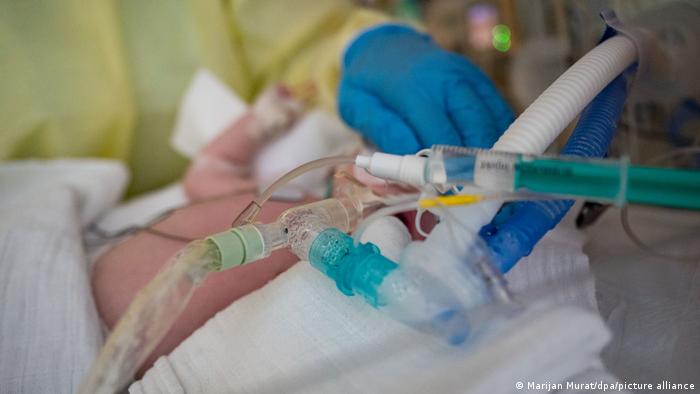
In addition to COVID-19, German hospitals are full of people with respiratory infections, especially young children
The hospitals are currently relatively full, especially with flu cases. “We see a combination of infections, some of which end up in intensive care units,” he told DW. “This includes fewer COVID patients but many influenza patients, particularly the elderly, and RS virus cases in children and adolescents.” In addition, there are sick clinic staff, which increases the pressure.
New COVID wave from China?
Meanwhile, the massive wave of corona infections in China is being observed with great concern. Especially since the government in Beijing has not only abolished all containment measures in the country, but has also allowed its citizens to travel abroad again. From January 8th, the previously mandatory quarantine when entering China will also be lifted.
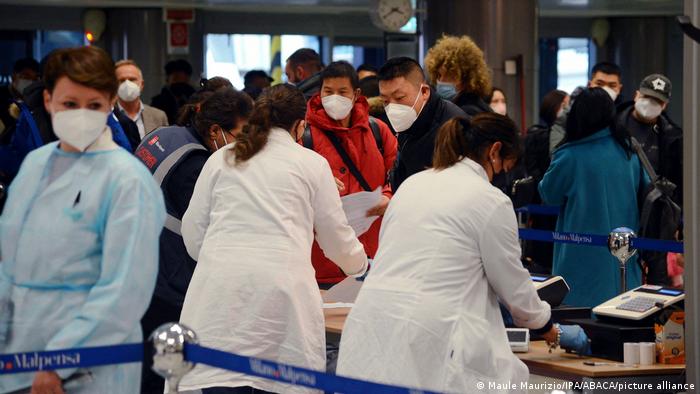
Anyone flying from China to Italy will be tested for the corona virus at the airport
The European Union has convened a meeting of its 27 members to define a common strategy. Italy has called for action at European level after tests at Milan airport on December 26 tested positive for more than half of the passengers on a plane from China. Anyone entering Italy from China must now take a mandatory corona test at the airport in Italy. Spain wants to follow this example.
Germany wants to wait and see on the China question
The USA (from January 5) and India (from January 1) announced that In the future, travelers will have to show a negative test result before departure. The German government, on the other hand, wants to monitor the situation first. So far there are no signs that a new variant has developed in China. Otherwise, that would make the country a variant area and lead to travel restrictions, said a spokesman for the Ministry of Health.
China recently reported between 20,000 and 30,000 new infections every day to the World Health Organization. However, the accuracy of these figures is questioned. “I'm not sure how exactly the Chinese authorities report and how well they test,” says virologist Salzberger. “It's hard to judge what's really happening there.”
This text was adapted from English.