Nvidia has introduced the next-gen GeForce RTX 4090 and GeForce RTX 4080 graphics cards with 12 and 16 GB VRAM based on the new Ada Lovelace architecture. Not surprisingly, the company's own upsampling technology DLSS also takes a step forward. Above all, DLSS 3 should deliver more FPS than DLSS 2. But RTX 40 is mandatory.
DLSS 3 vs. DLSS 2
DLSS 3 builds on DLSS 2. The approach sounds identical at first: With the help of so-called motion vectors, the movements of pixels in several previous frames are determined and this information is then used for the current frame. This makes it possible with DLSS 2 or other temporal upsampling methods to correctly display objects that are actually not correctly displayed – because the information required for this is not available in the current, but in the combined, previous frames.
quasi a better combination of DLSS 1 and DLSS 2
But DLSS 3 goes even further and, with the help of a neural network, creates several future frames (optical multi-frame generation) using the information previously collected temporally, and thus represents something like a combination of DLSS 1 and DLSS 2. The so-called DLSS frame generation Convolutional Autoencoder creates the additional frames by analyzing 4 previous frames (the current one plus 3 previous ones) and game data such as geometry and motion vectors. There is also an “optical flow accelerator” analysis that captures the movement of other pixels between different frames that are not included in the motion vectors. The method used enables DLSS to reconstruct up to seven eighths of the displayed pixels, which should massively reduce performance costs.
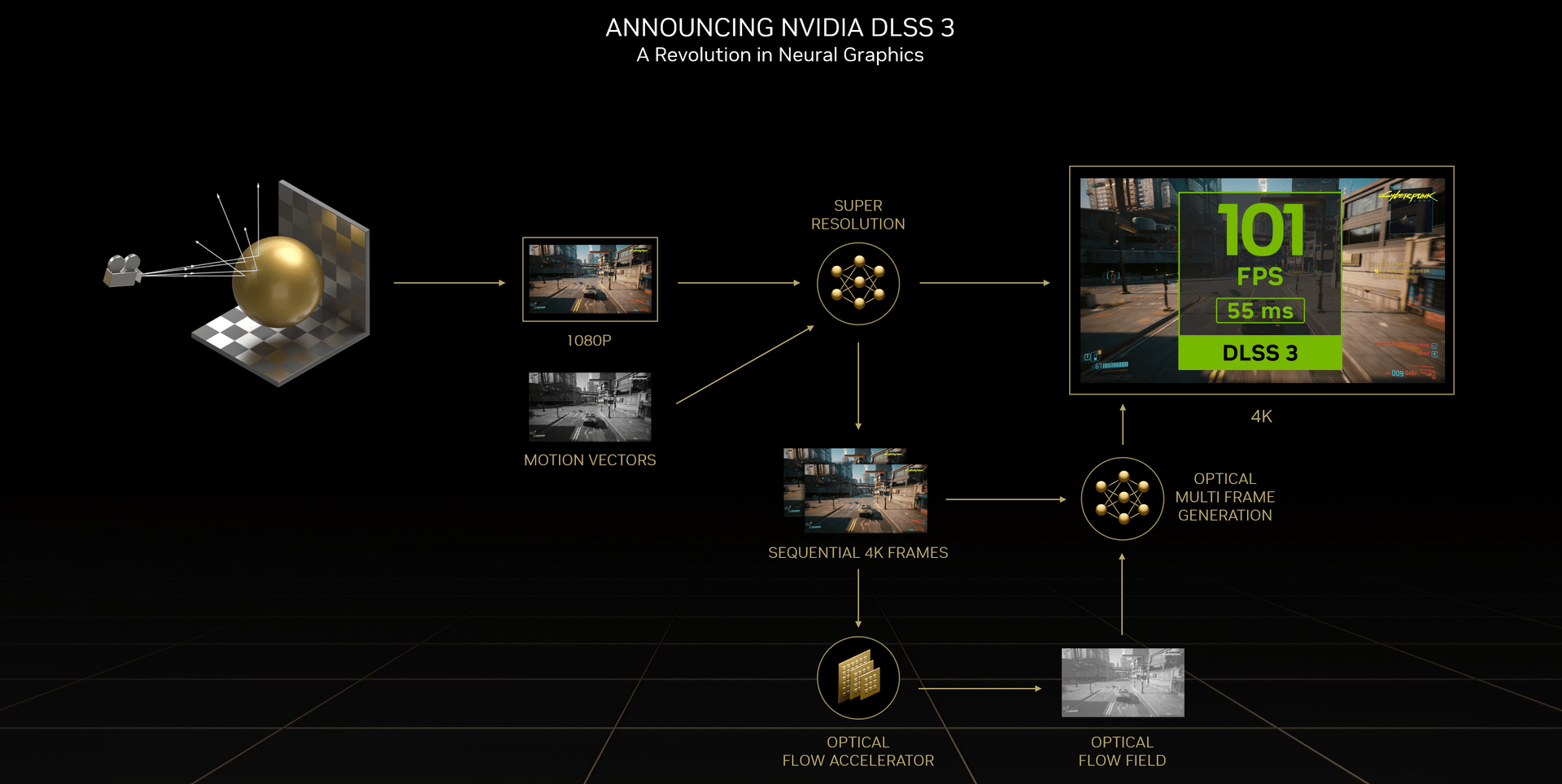 Nvidia DLSS 3 on GeForce RTX 4000 (Image: Nvidia)
 Image 1 of 4
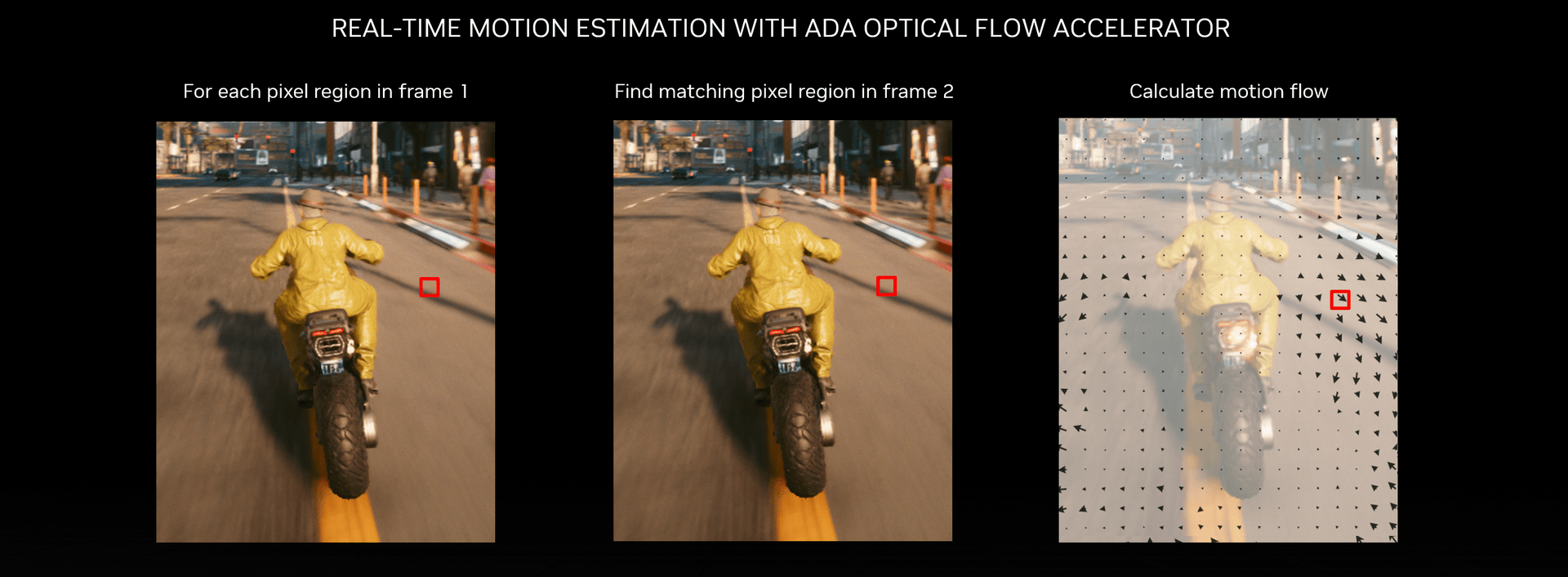
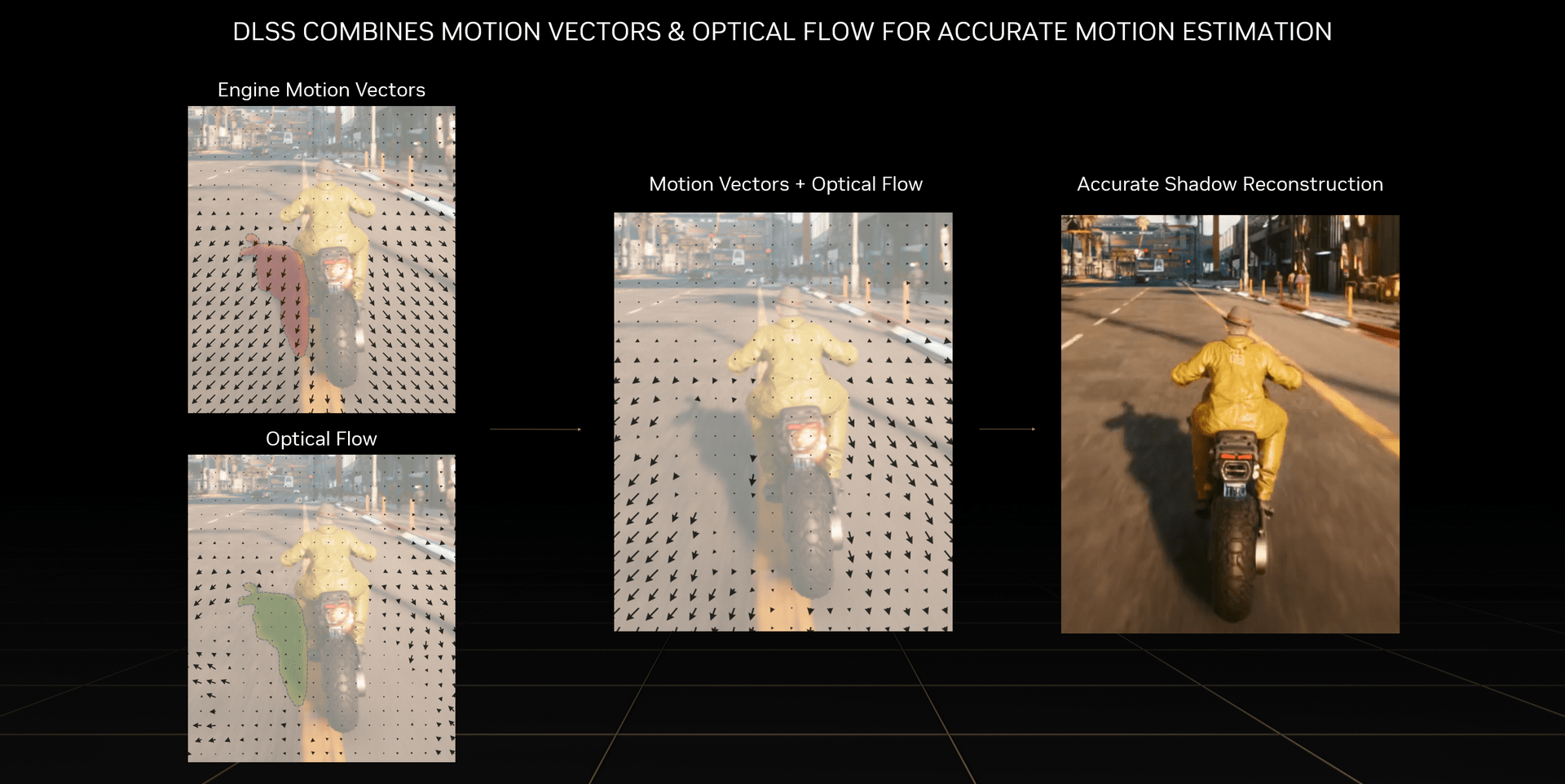
Nvidia DLSS 3 on GeForce RTX 4000 (Image: Nvidia)
DLSS 3 requires RTX 4000
According to Nvidia, the neural network should benefit significantly from the new tensor cores on Ada Lovelace – and also requires the new tensor cores. This means: DLSS 3 will only be available on GeForce RTX 4000 graphics cards.
In addition, DLSS 3 also integrates Reflex to reduce the game's input lag. Nvidia speaks of a latency that is up to halved.
Up to 4× the performance in the GPU and 2× in the CPU limit
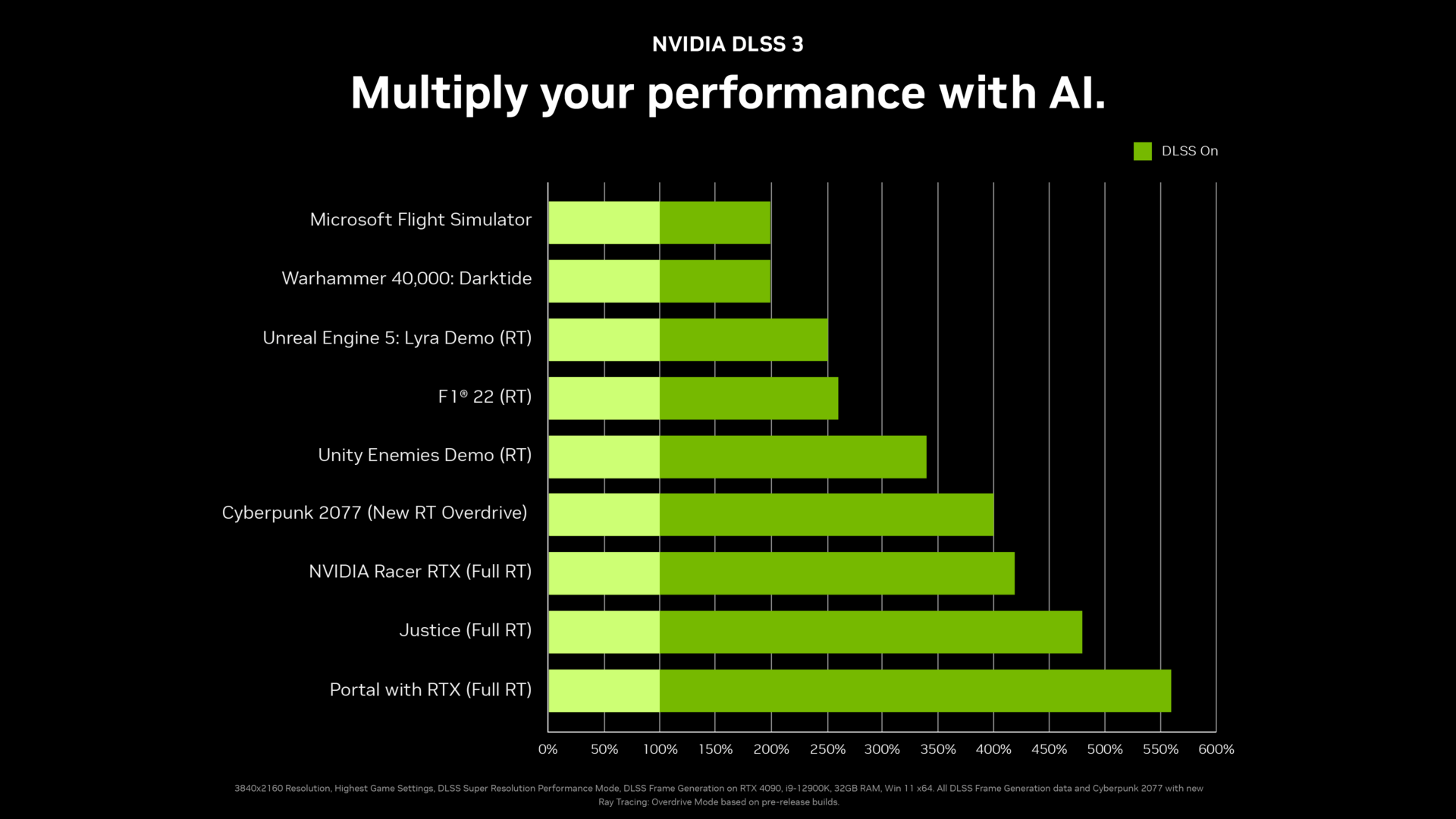
In a preliminary version of Cyberpunk 2077, DLSS 3 is said to have increased the frame rate by a factor of 4 compared to native rendering and at the same time halved the input lag. Without further details such as the render resolution, the specification is impressive, but ultimately not very meaningful. In addition, it is open what the image quality looks like. Although there is a video with DLSS 3 in Cyberpunk 2077, it is very short and the YouTube compression is not helpful for a first analysis.
Since the DLSS frame generation runs purely as a post-processing effect on the GPU, DLSS 3 can also increase the frame rate in purely CPU-limited scenarios. Of course, DLSS 3 cannot then work with new data from the CPU, but it can create new frames based on older data and thus increase the frame rate. Even if the input lag shouldn't improve in this case, despite the higher frame rate. In a pre-release version of Microsoft Flight Simulator, DLSS 3 is said to run twice as fast as with the native resolution in a CPU-limited scenario. But here, too, further details are missing in order to be able to assess the result.
35 games announced, starting in October
Nvidia has announced DLSS 3 for more than 35 games and applications, apart from the already mentioned Cyberpunk 2077 as well as Microsoft Flight Simulator, A Plague Tale Requiem, Dying Light 2, F1 22, Hitman 3, Hogwarts Legacy, Stalker 2 and The Witcher 3 will also be included. In addition, DLSS 3 has been integrated into the Unreal and Unity engines. DLSS 3 is planned to be integrated into the first game later in October.
 Nvidia DLSS 3 on GeForce RTX 4000 (Image: Nvidia)