She was a revue star, a diva, a fighter for freedom and against racism. Josephine Baker still has a special radiance today. The Bundeskunsthalle is now devoting an exhibition to the icon of the 1920s.

Star photo: Josephine Baker posing on a tiger skin
“Freedom, Equality, Humanity” is the title of the exhibition with which the Bundeskunsthalle in Bonn would like to honor the life and work of Josephine Baker . The focus is on the lifetime achievements of the American artist.
Even if it's the iconic image that many people associate with Josephine Baker: “One hundred years of banana rock is enough,” says Baker biographer Mona Horncastle in an interview with DW, referring to the show star's role model function. With her adaptability, her self-empowerment and the self-determined narrative of her life, Baker is an inspiration and a projection screen for artists and future generations. Horncastle finds your call for a universal human right, for freedom and equal rights for all, “incredibly motivating” – today just as it was then, when diversity was still far from being an issue capable of consensus.
Biography and exhibition contribute to the fact that Josephine Baker is no longer known only as the exotic dancer who, at the beginning of her career, served the public taste of the 1920s in a “questionable costume” with African clichés. But Baker's stage career is also remarkable. In a good 50 years she will be dancing and singing her way from the slums of St. Louis to the big stages of Europe.
Josephine Baker is said to have received more than 1,500 marriage proposals. In 1927, the famous dancer earned more than any other entertainer in Europe. She's only 20 at the time. With her, the world-famous “Revue Nègre” and “Hot Jazz” come to the European cultural metropolises. Artists and writers like Picasso and Ernest Hemingway, the architect Le Corbusier and actors and theater people like Jean Gabin and Max Reinhardt lie at her feet in Paris, Madrid and Berlin. The French artist Jean Cocteau raves euphorically: “This beautiful idol made of brown steel, irony and gold!”
From the slums to Broadway
As a child, Josephine Baker didn't have much to do laugh. She has to work hard early and earn money. In 1917, at the age of eleven, she witnessed the pogroms in which almost 100 black people were lynched.
She was born in Missouri/USA, in the slums of St. Louis. Freda Josephine McDonald is on her birth certificate, dated June 3, 1906: illegitimate daughter of a black woman and a white Spaniard. The father, a musician of Jewish descent, is unemployed and quickly flees.
She works as a maid for rich white families. But she quickly learns the everyday racism of the propertied class. At 15, the mother marries off her daughter so that she can be taken care of. From this brief association, Josephine retains her surname Baker.
She helps out as a dresser for a traveling troupe, but she has to disguise her age: no theater director would have hired a teenager. When a dancer falls ill, she bravely seizes her chance and performs with the troupe. She conquers her world on stage.

Baker's breakthrough came with the “Revue Nègre”
And she is ambitious and tough: at 16 she dances as an understudy in a black musical, followed in 1922 by appearances in the successful show “Chocolate Dandies”, which has guest performances in Moscow and St. Petersburg. With this revue she also succeeds in making the leap to New York's Broadway – and shortly thereafter to Europe.
Paris as a glamorous backdrop
In the fashionable Paris “Theatre des Champs Elysées” she appeared in a dance revue in 1925 – dressed only in a few feathers and a pearl necklace. Her sensual eroticism, her well-toned body and her legendary Charleston numbers tear the audience off their chairs with enthusiasm. Famous is above all her “danse sauvage”, her banana dance in a skirt made of 16 bananas.
Overnight she becomes a celebrated star. She can be seen in the famous variety theater “Folies Bergère” in Paris and in many other cities in Europe when she embarks on tour with the “Revue Nègre”. On January 14, 1926, she wowed a German audience for the first time on Kurfürstendamm in Berlin.
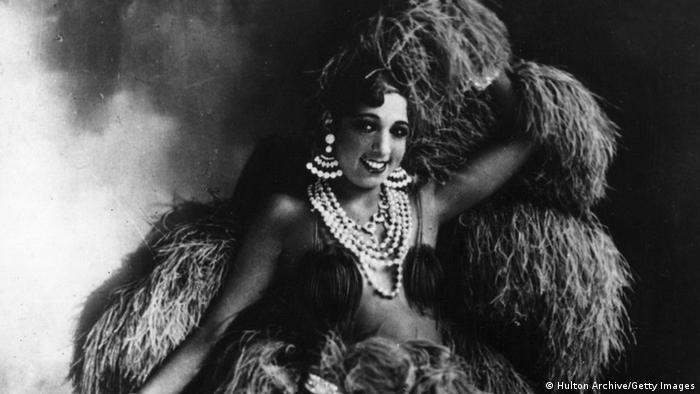
The men were crazy about Josephine Baker
As an exotic dancer, Josephine Baker is idolized on the tours . Her admirers shower her with expensive gifts and vows of love. Unperturbed, the diva keeps countless lovers, sleeps with both men and women – and marries a Sicilian imposter in order to adorn herself with his aristocratic title. But despite her wealth, she will not be happy.
“Hot Jazz” conquers Europe's stages
Josephine Baker is the sex symbol of her time in the “Roaring Twenties”. She made “hot jazz” socially acceptable in Paris, Berlin and other cities in the 1920s. When she sings, her lyrics are rather half-silk. She plays with her image as “Black Venus”. Every performance is accompanied by a huge hype. In Munich, however, she was banned from performing because of the expected “violation of public decency”.
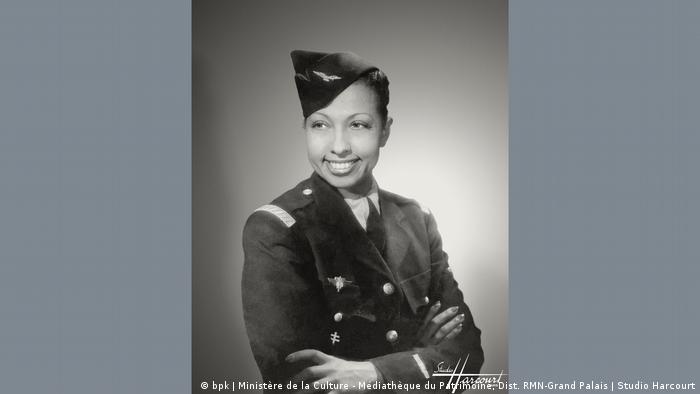
Joséphine Baker in the Harcourt studio in Paris, 1948
During a US tour, Baker, who is celebrated in Europe as a black revue star, experiences massive racist hostilities. After the show, she has to go through the servants' entrance. Disappointed, she finally became a French citizen in 1937 – thanks to her marriage to the French Jew and industrial magnate Jean Lion.
“Resistance” fighter against the Nazis
The outbreak of the Second World War in 1939 and the occupation of France by Hitler's Wehrmacht fundamentally changed Josephine Baker's life. At first she works for the Red Cross, helping where she can.
Through contacts with the French resistance movement “Résistance” she can be trained as an agent of the French secret police. Hidden in her tour luggage, she smuggles letters and secret documents across the border. At the end of the war, General Charles De Gaulle awarded her the ribbon of the French Legion of Honour.
Founder of the “Rainbow Family”
Political commitment also characterized the period after the war. Together with her third husband, Josephine Baker expands the castle “Les Milandes” in the Dordogne into a place of pilgrimage of racial and religious tolerance. She had adopted twelve children of completely different backgrounds and religions: her “rainbow family”.
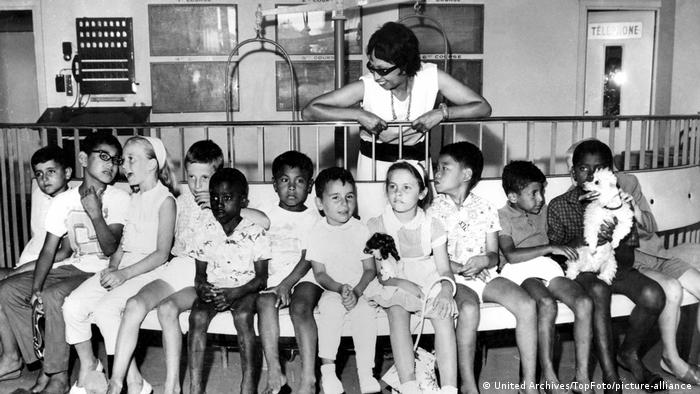
Josephine Baker adopted twelve children of different backgrounds and religions
But Baker is constantly touring and hardly at home. She leaves raising the children to changing nannies and her husband. In 1963 she marched alongside Martin Luther King took part in the legendary “March on Washington” in the USA to protest against racism in the USA.
Your luxurious life devours huge sums of money, in the end Josephine Baker is heavily in debt. In May 1968 her property was foreclosed on. Her husband left her a long time ago. Her friend Princess Grace ensures that the rainbow family is accommodated by the Red Cross in Monaco.
A comeback in 1973 at New York's Carnegie Hall and her legendary show in 1975 at the Paris Bobino Theater Josephine Baker once again great press hype. But the aging diva can't repeat her previous successes. On April 12, 1975, she died of heart failure at the age of 68. Her fame as a dancer will never end.
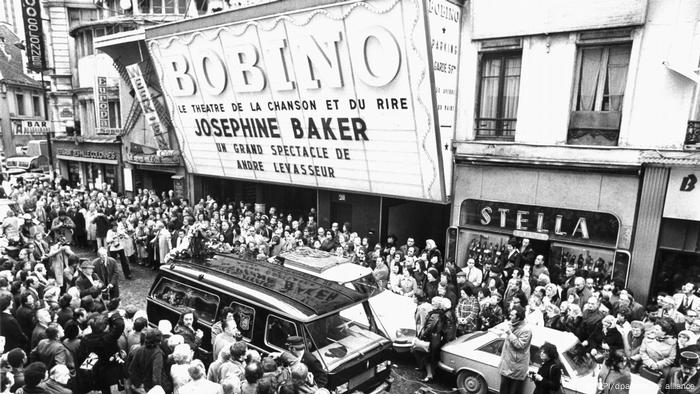
Mourning fans stand by the roadside as the chariot with the mortal remains Josephine Bakers drives past the theater where she had recently performed
A recent biography of Josephine Baker is published by Molden Verlag (2020) by Mona Horncastle.
This is the updated version of a Article from 03.05.2021.