On its 75th Independence Day, Israel is at a crossroads. The judicial reform planned by the right-wing government has led to a deep division in society.
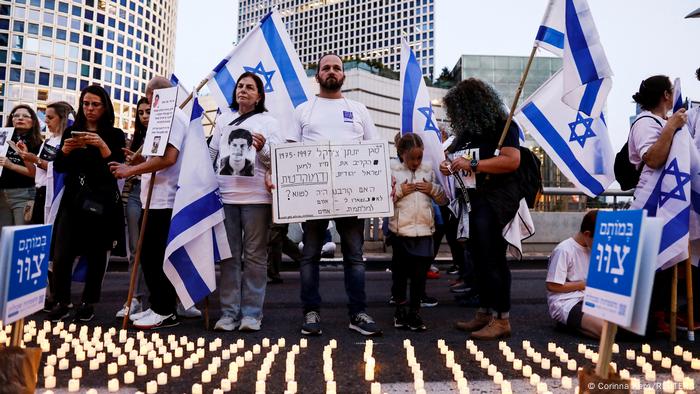
Demonstration against the planned judicial reform in Israel
Every Saturday, Yehudit Elkana can be found at one of the demonstrations against the right-wing government's controversial judicial reform in Jerusalem – as can thousands of Israelis with her. “I'm actually an optimist by nature,” says the retired physical chemist and human rights activist, “but I can't be right now. But we won't back down.”
In the last few Four months later, the division in society between opponents and supporters of the controversial plan has deepened. Opponents describe the judicial reform as a threat to Israeli democracy. The proponents consider it necessary to limit what they consider to be too much power for the Supreme Court.
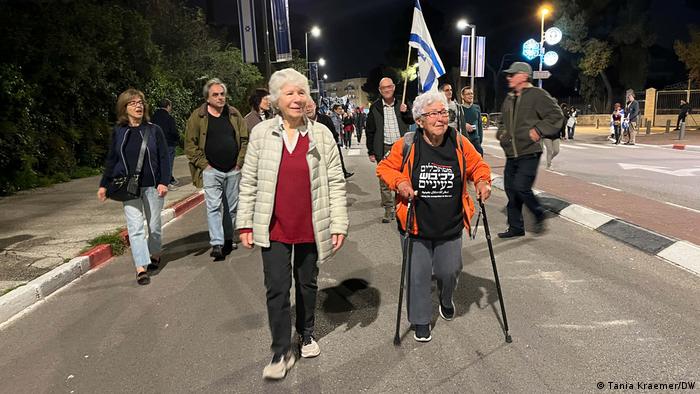
Yehudit Elkana (left) regularly goes to the demonstrations against the planned judicial reform
Eyewitness to Israel's history
Elkana, born in Jerusalem in 1935, belongs to the generation of Israelis who helped build the country. Her parents fled Nazi Germany in the early 1930s and had to start a new life in what was then the British Mandate of Palestine. In all the years since then, she has witnessed many crises and wars, but also moments of hope from her point of view, such as the proclamation of the State of Israel by David Ben-Gurion in May 1948.
“I still remember good for the photos in the newspapers, for the happiness, for the way we danced on Rothschild Boulevard. As a child, I didn't feel the beginning of the war that broke out immediately afterwards.” Because immediately after When the state was founded, Israel was attacked by Egyptian, Iraqi, Jordanian, Lebanese and Syrian units.
Today, 75 years later, Elkanah is very concerned. The dispute over judicial reform “could lead to a civil war. Neither side will give in. It's very sad”.
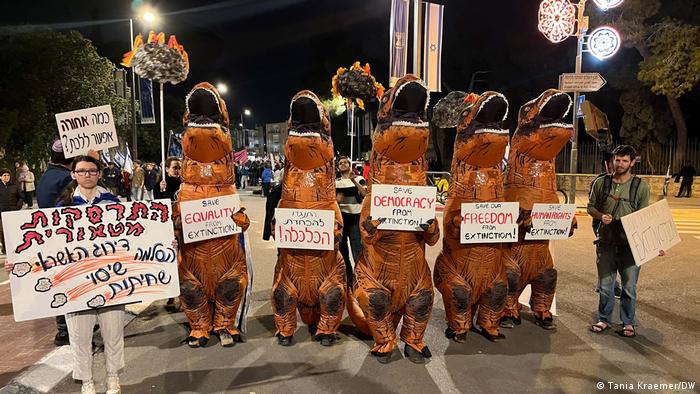
Save Democracy reads some of the placards at this demonstration in Jerusalem
Israel is at a crossroads, agrees Tomer Persico, research associate at the Shalom Hartmann Institute in Jerusalem. And not just because of the controversial judicial reform.
“Various issues that have long been suppressed or ignored are now surfacing. The openness of Israel's society, the relationship between state and religion, the relationship between the secular majority and the ultra-Orthodox minority in the army… all these things are now being discussed,” says Persico. The majority of ultra-Orthodox youngsters do not serve in the army, which is always a source of fundamental debate.
The 'left' perspective
In a café in Tel Aviv-Jaffa, the student and Activist Roni Amir with her friend Nili Rozen on the protests and the future of Israel. It is important to the 24-year-old to go to one of the demonstrations every week. Above all, they want the end of the Israeli occupation.
“At the demonstrations, I belong to the part of the protesters that we call the 'anti-occupation bloc'. We see the reason for everything that is happening in the occupation. We also want a real democracy, a country that can not defined by nationality and religion.” She calls for a one-state solution in which Palestinians become citizens with equal rights.
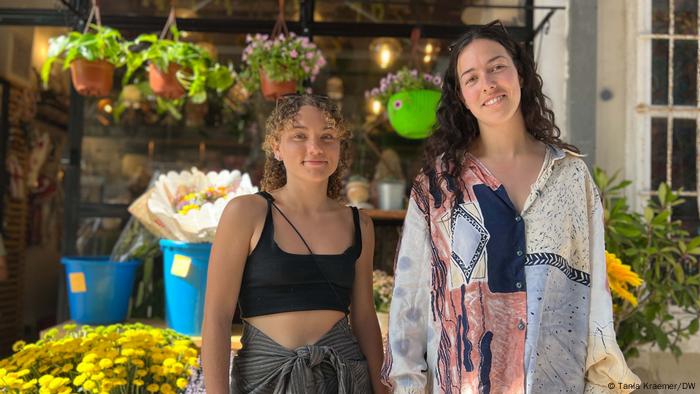
Roni Amir (right) and Nili Rozen (left) also attend the demos. But they also want an end to the Israeli military occupation.
Both also find that Israel neglects issues such as education and the high cost of living. “We are only ever concerned with security issues such as our situation in the Middle East,” says Amir. The current atmosphere in the country is also causing her problems. “If you're an activist trying to help Palestinians, you're treated like a traitor instead of saying, 'It's good that someone is helping others.'”
The pair's view of the Israeli-Palestinian conflict isn't exactly popular these days — at least not among young Jewish Israelis who didn't live to see the peace process of the 1990s. The Oslo peace agreement gave hope, at least for a short time, that Israelis and Palestinians are on the way to a two-state solution.
Youth tend to be right-wing conservative
According to Tomer Persico, the Israeli left camp today has little ideological clout. “Certainly the struggle to end the occupation, which used to be led by groups like Shalom Achshav (Peace Now), is much weaker today. Today there is a kind of consensus in Israel that there is nothing that can be done about it at the moment. It there is no real partner on the [Palestinian – editor's note] side.”
According to the 2022 Israeli Democracy Index, up to 75 percent of Jewish Israelis between the ages of 18 and 34 describe themselves as “right-wing conservatives.” A trend that has only developed in the past ten years – even if, according to experts, there are many different reasons for it.
Some of today's young Israelis grew up under the impression of the second Palestinian Intifada, which gripped the country from 2000 to 2005. This generation was also shaped by the various Gaza wars and the evacuation of Israeli settlements in the Gaza Strip. In addition, young people increasingly identify as religious or come from more conservative, ultra-orthodox families.
The trend was also partly reflected in the last election, when the far-right party alliance “Religious Zionism” won 14 of the 120 seats in the Israeli parliament, the Knesset. Their extremist party leaders are now ministers in Prime Minister Benjamin Netanyahu's coalition government.
They are “ideologically very committed,” says Tomer Persico. “They have set themselves a very clear goal. And young people are attracted to this kind of determination that they don't find anywhere else”.
< h2>The right perspective
It's people like Naor Meningher. The 34-year-old media worker from Tel Aviv is disappointed by the protests and hopes that at least part of the judicial reform will be implemented. “Four months ago we had an election. And you can't deny the results. The government got a very clear mandate from the people to act,” says Meningher.

Naor Meningher from Tel Aviv defends the planned judicial reform
Israel is the only country that can offer Jews security. “My grandparents came here from Romania in the 1970s. They fled a ruthless communist dictatorship and found refuge here. I don't think Jews have an alternative. For me, this is my home, and it will be stay like this forever.”
Meningher currently sees no solution to the Palestinian-Israeli conflict. “I think the best thing would be to keep the status quo that we have now and annex what we can, especially the least populated areas,” says He is looking at the occupied West Bank. “Palestinians are my enemies. I have no interest in them getting their own sovereign state,” he says.
“We have to stay optimistic”
It is precisely this view that worries Yehudit Elkana. At the demonstration against judicial reform in Jerusalem, she protested in the midst of a group of opponents of the Israeli occupation. “Right after 1967 I went to Jerusalem's Old City to see everything,” she recalls. East Jerusalem was controlled by Jordan until the Six-Day War in 1967, but was then conquered and occupied by Israel West Bank should eventually be returned.”
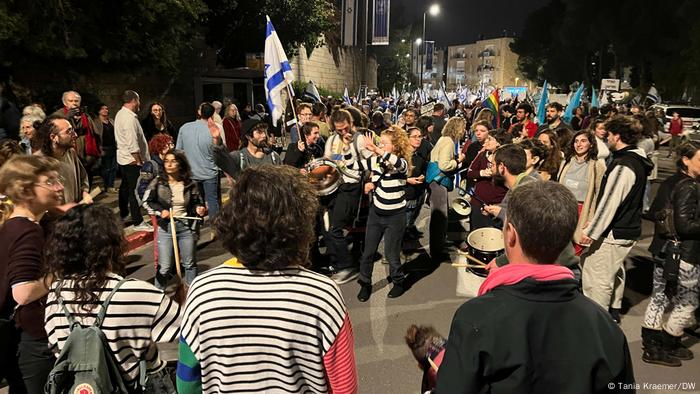
Demonstration against judicial reform in Jerusalem in April 2023.< /p>
Nevertheless, the focus is initially on the protest against the judicial reform. Elkana is also counting on the younger generation to find solutions to the many challenges. “We have to remain optimistic, despite the pessimistic mood. We must do what we can.”