Pablo Picasso died 50 years ago on April 8th. In 2023, museums around the world will commemorate one of the most researched artists, about whom there is still something new to say.

Pablo Picasso is considered one of the most productive and versatile artists of all time. In seven decades he created thousands of paintings and sculptures in a wide variety of styles.
The works by the Spanish-born artist continue to achieve some of the highest sales at auctions worldwide. Paintings such as “Seated Woman at the Window” were sold at Christie's in New York in May 2021 for 103 million dollars (98 million euros), in 2015 the oil painting “The Women of Algiers” was auctioned for the then record sum of 179 million dollars.
-
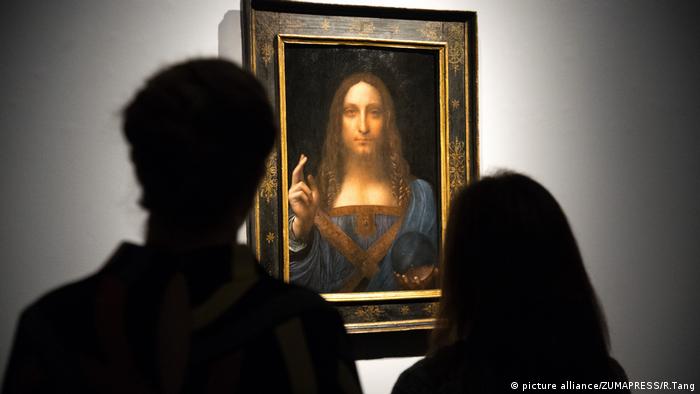 The most expensive works of art in the world
Salvator Mundi: 450 million US dollars
An unknown bidder paid this amount in November 2017 at the New York auction house Christie's for perhaps the only privately owned work by da Vinci. Created around 1500, it is now one of the fewer than 20 surviving paintings by the master. In 1958 the work had changed hands for $60 – believing it was not an original. The authenticity is still disputed today.
 The most expensive works of art in the world
40.8 million euros for the “Hell of the Birds”
German artist Max Beckmann's painting 'Hell of the Birds' fetched a record £36m at Christie's in London in June. That's the equivalent of 40.8 million euros. It is the highest price for a work of German Expressionism. However, the sale price is far from reaching the ten most expensive works of art sold at auction.
-
 The most expensive works of art in the world
The women of Algiers ($179.4 million)
The work by Pablo Picasso was the most expensive painting ever to go under the hammer. In 1955, the Spanish artist painted the painting inspired by Eugène Delacroix. It was auctioned at Christie's in New York in 2015 for $179.4 million. It has been in private ownership since then.
-
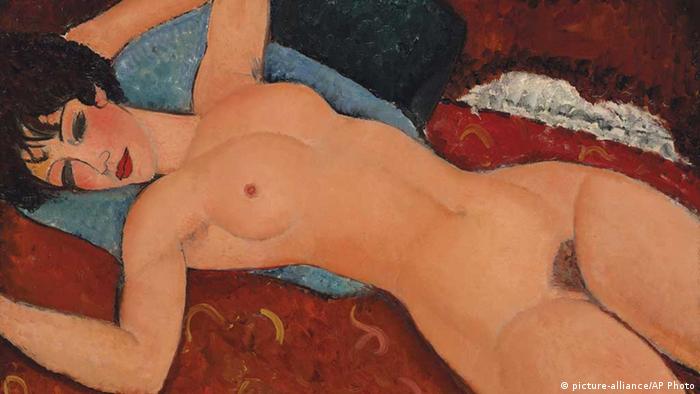 The most expensive works of art in the world
Nu couché ($170.4 million)
Italian painter Amedeo Modigliani painted this picture in 1917, three years before his death. In November 2015, it was auctioned at Christie's in New York – and not only achieved a proud price, but also took second place in the ranking of the most expensive works of art in the world at the time. The new owner is Liu Yiqian, businessman and billionaire from Shanghai.
-
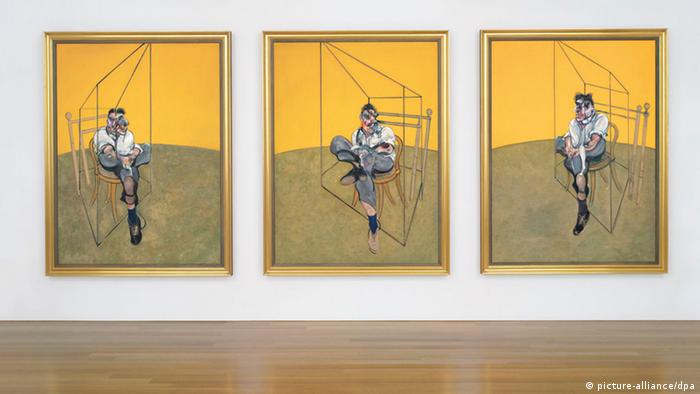 The most expensive works of art in the world
Three Studies of Lucian Freud ($142.4 million)
Francis Bacon was an Irish painter and created this triptych, a three-part painting, in 1969. His works dealt with the representation of the human body – here with the British painter Lucian Freud. In 2013, it was sold at Christie's for $142.4 million. It is now owned by American art collector Elaine Wynn.
-
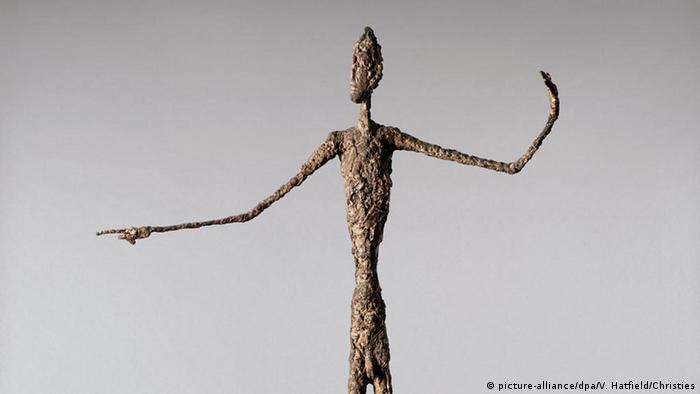 The world's most expensive works of art
Man pointing ($141.3 million)
It doesn't always have to be a painting. This bronze figure by Alberto Giacometti, a Swiss artist, went under the hammer in May 2015. The buyer, a very wealthy hedge fund manager named Steven Cohen, bought the life-size sculpture for $141.3 million at Christie's in New York. This makes the “Pointing Man” the most expensive sculpture in the world.
-
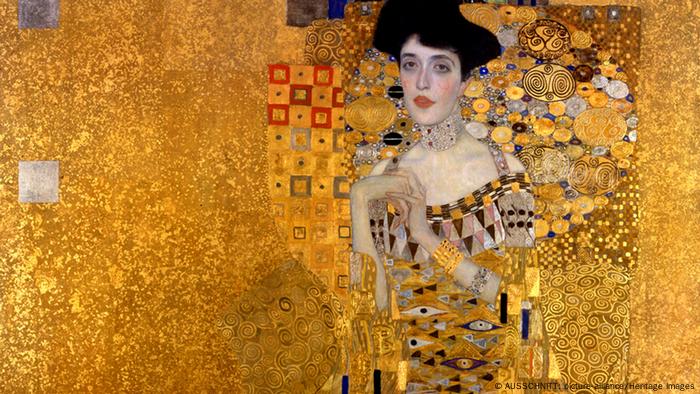 The most expensive works of art in the world
Golden Adele ($135 million)
The “Portrait of Adele Bloch-Bauer I” is better known as “Golden Adele” and was painted in 1907 by the Austrian Gustav Klimt. The American entrepreneur Ronald Lauder acquired it in 2006 for the Neue Galerie in Manhattan, New York. It has been on display there ever since. Although this was a private sale, it was initiated by Christie's.
-
 The world's most expensive artworks
The Scream ($119.9 million)
“The Scream” by Norwegian painter Edvard Munch is a well-known motif, but what is less well known is that there are four different versions. The picture is considered one of the most famous paintings in the world, alongside Da Vinci's “Mona Lisa” and Van Gogh's “Sunflowers”. In 2012, the 1895 pastel version was auctioned at Sotheby's in New York. The buyer was the American entrepreneur Leon Black.
-
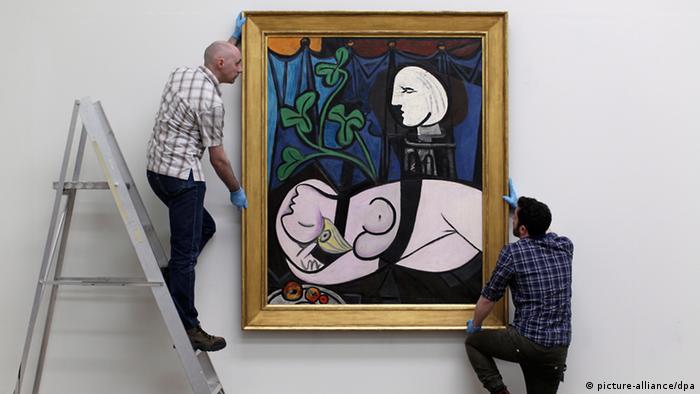 The most expensive works of art of the world
Nude with Green Leaves and Bust (US$106.5 million)
Pablo Picasso painted this oil painting in a single day – March 8, 1932. It is considered almost unknown, but an anonymous buyer bought it Artwork worth $106.5 million on May 4, 2010. Privately owned since the New York auction, it was loaned to London's Tate Modern gallery in 2011.
-
 The most expensive works of art in the world
Silver Car Crash ($105.4 million)
In 1963, American artist Andy Warhol produced this screen print, which shows a car crash in individual images. The masterpiece was privately owned for 20 years before being sold at Sotheby's in November 2013. The buyer's name was never disclosed. It is the pop artist's most expensive work ever to be auctioned.
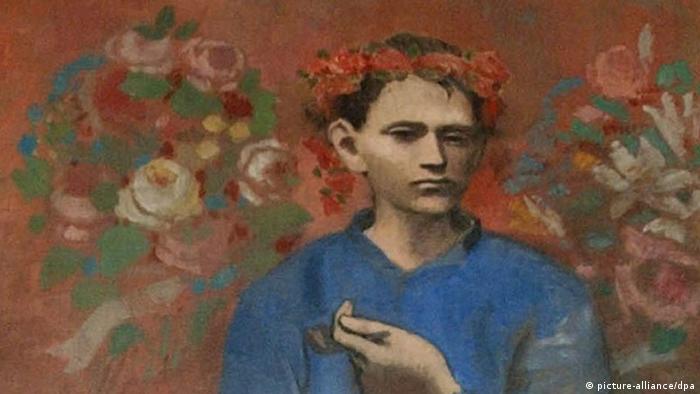 World's Most Expensive Artwork
Boy with a Pipe ($104.2 million)
This oil painting is also by Pablo Picasso, painted in 1905. It marks the transition from the Blue to his Pink period. Picasso began to add pink tones to the blue. In 2004 it was auctioned at Sotheby's in New York, a buyer was never officially announced. However, there are suspicions that it could be the Italian pasta giant Guido Maria Barilla.
-
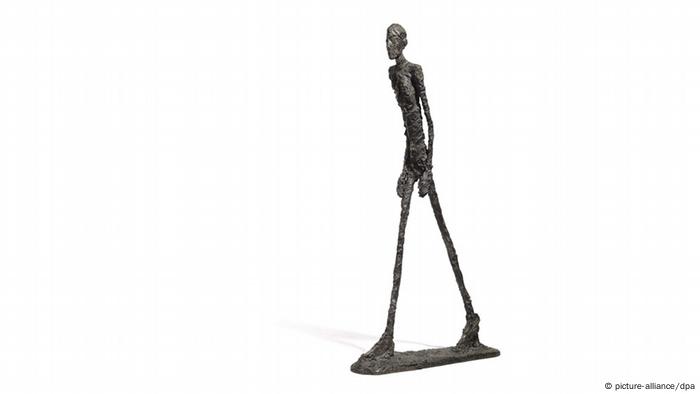 The most expensive works of art in the world
Striding man (103.7 million US dollars)
Another bronze figure by Alberto Giacometti fetched over $100 million at auction at Sotheby's in London. The sculpture is now owned by the Brazilian Lily Safra. The sculpture was created in 1960 and is one of the most important works of Swiss art of the 20th century. It can still be seen today on the 100 Swiss franc note.
On the 50th anniversary of his death on April 8, 2023, a transnational international cultural program will start. Under the motto “Picasso Celebration 1973-2023”, special exhibitions are planned not only in Spain, his country of birth, but also in his second home France, Germany and the USA.
While his artistic genius is undisputed, in the course of the #MeToo movement his dealing with women is increasingly being discussed.
Prodigy of painting
Picasso will become on 25. Born October 1881 in Málaga, Andalusia. His father, Don Jose Ruiz y Blasco, is an artist and makes a living painting animals, mostly pigeons, and teaching art. His son learned to draw from him at the age of only seven.
-
 Pablo Picasso – the art genius
“The Old Guitarist”
Pablo Picasso painted this picture of an old guitarist in the streets of Barcelona in 1903-1904. It is one of the most important works from his Blue Period, during which he painted predominantly in shades of blue to reflect his somber mood. Recent X-ray and infrared examinations revealed that there are other figures hidden behind the painting.
-
 Pablo Picasso – the art genius
“Portrait of Gertrude Stein”
The Blue Period was followed by the Pink Period. From her comes the portrait of the American writer and art collector Gertrude Stein, painted in 1905-1906. Stein, who lived in Paris, was a patron of European avant-garde art and instrumental in making Pablo Picasso famous.
 Pablo Picasso – the art genius
“Les Demoiselles d'Avignon”
Picasso's “Les Demoiselles d'Avignon”. 'Avignon' (The Young Ladies of Avignon) is considered a seminal example of Cubism. Completed in 1907, it caused controversy for its extraordinary depiction of female bodies and distorted perspectives. If you want to see for yourself, you can examine the painting at the Museum of Modern Art in New York.
-
 Pablo Picasso – the art genius
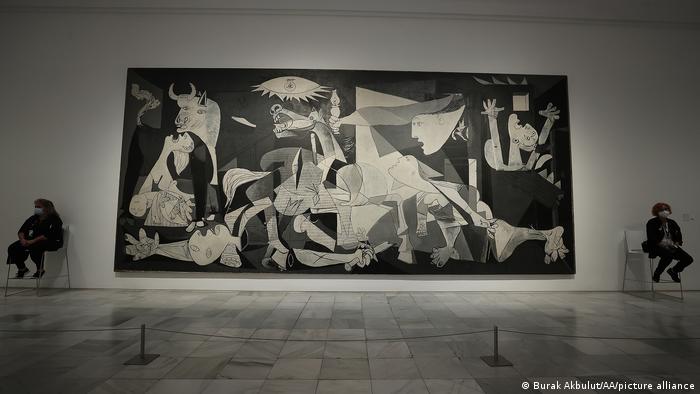
“Guernica”
With “Guernica”, which Picasso painted for an exhibition in Paris in 1937, the Spanish painter reacted to the Nazi bombing of the Basque city of Guernica in the same year. The brutality of war is represented by various metaphorical figures such as a bull, a tortured horse or a crying woman holding her dead child.
-
 Pablo Picasso – the art genius
“Dora Maar with cat”
Picasso created this painting of his lover Dora Maar in 1941. She was his muse and companion – for eight years. He then parted ways for the far younger Françoise Gilot. Picasso was not particularly good with women, as both Gilot and his granddaughter Marina Picasso describe in their memoirs. Today Picasso would be described as macho and sexist.
-
 Pablo Picasso – the art genius
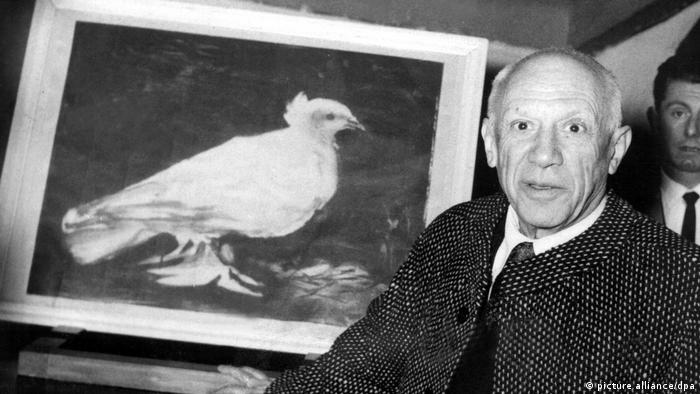
“The Dove”
Picasso created this lithograph in 1949 for a poster for the Paris World Peace Congress in 1949. A year later, Picasso designed the lithograph “Flying Dove” for the World Peace Congress in Sheffield, which, as the dove of peace, became the ultimate symbol of peace and is probably Picasso's most famous picture.
-
 Pablo Picasso – the art genius
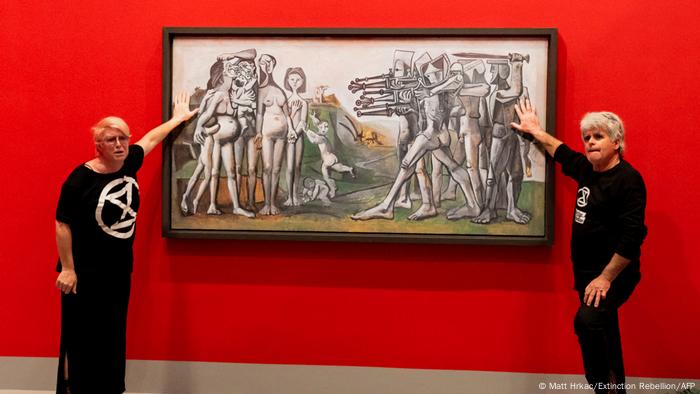
“Massacre in Korea”
Completed in 1951, this painting depicts the murder of innocent civilians by US soldiers during the Korean War. Experts believe Picasso was inspired by works such as Goya's The Third of May 1808 (1814) and Edouard Manet's The Shooting of Emperor Maximilian (1868). would. Recently, climate activists in Australia taped their hands to Picasso's anti-war work in protest.
At the age of 13, Picasso began his studies at the Escola de la Llotja, the art school in Barcelona where his father also taught. Just two years later he paints his first large-scale oil painting for an exhibition in the city, “The First Communion”. The work is already considered a first masterpiece.
In 1897 Picasso moved to the Real Academia de Bellas Artes de San Fernando in Madrid. During this time he also dealt intensively with the paintings of Diego Velázquez, Rembrandt, Jan Vermeer and Francisco de Goya in the Prado Museum. At the beginning of the 1900s, the young artist was drawn to Paris, the capital of the avant-garde.
Picasso worked in creative periods
Picasso's artistic output can be divided into different phases.
The first phase, known as the Blue Period, lasted from 1901 to 1904 and is widely believed to have been marked by the suicide of Picasso's close friend, the Spanish artist Carlos Casagemas, triggered. The first painting of this period, “The Death of Casagemas” (1901), is emblematic of the somber mood and shades of blue that characterize this period.
This is followed by the Pink Period (1904-1906), in which Picasso's color palette consists of pink, light blue and orange. The portrait of Gertrude Stein, which he paints shortly after meeting the American writer in one of her salons, also dates back to this period.
It was during this phase that Picasso also met Fernande Olivier, a French artist , who later becomes his muse and lover.
Turning to Cubism
With the painting “Les Demoiselles d'Avignon” (1906-1907), Picasso achieved world fame and is celebrated as a pioneer of modern art. The bizarre distortion of the female body shapes shatters all previous notions of perspective. The painting is considered to be groundbreaking for the style of cubism.
Together with his painter friend Georges Braque, Picasso continued to develop cubism in the following years. “Girl with a mandolin” (1910) and “Still life with a bottle of rum” (1911) fall into this period.
Statement against the war
One of the most famous works was created in 1937: “Guernica” is still considered the most important anti-war painting of all time, a synonym for the suffering of the civilian population in the Spanish Civil War. Picasso painted it as a reaction to the bombing of the small Basque town of the same name in northern Spain the German Condor Legion, sent by Adolf Hitler to train in Spain for the Blitz.
Although “Guernica” has Cubist elements, it also marks the painter's turn to Surrealism.
Other anti-war works are “Das Beinhaus” (1944-45), which deals with the Holocaust, and “Massaker  ;in Korea” (1951) and the image of the dove, which became the symbol of the peace movement.
Toxic masculinity
In recent years – also in the course of the #MeToo movement – Picasso's attitude towards women, especially his lovers, has been examined more closely. Picasso's treatment of women needs to be recontextualized in his work, writes Shannon Lee, American art commentator, in Artspace magazine. “Picasso himself remarked that his entire oeuvre can be divided into seven distinct styles, each documenting his relationship with the seven women in his life – Fernande Olivier, Eva Gouel, Olga Khokhlova, Marie-Thérèse Walter, Dora Maar, Françoise Gilot and Jacqueline Roque”.
Picasso, Lee continues, “brought an exceptionally miserable life to pretty much every woman he pretended to love.”
Lee also quotes Picasso's granddaughter Marina, who in “And Still a Picasso. Living in the Shadow of My Grandfather” (2001) notes: “He subdued her to his animal sexuality, tamed her, bewitched her, sucked her up and crushed her on his canvas. After nights of extracting her essence, he discarded her as soon as she bled dry were.”
Picasso depicted himself as a mythical Minotaur in several of his paintings; his muses are victims of his bestial aggression.
Francoise Gilot, an artist whom Picasso falls in love with while still in a relationship with the photographer Dora Maar, is seen as the exception to the rule. With her he has two children, Claude and Paloma. Gilot is believed to be the only woman who left Picasso.
At the age of 81 Picasso married his second wife, Jacqueline Roque, 46 years his junior. They live together in southern France until his death. Shortly after his death she commits suicide. Picasso works until the end obsessed. In 1972, the artist seems to foreshadow death: he creates a series of self-portraits in which he replaces his head with a mask that sometimes takes on the appearance of a skull.
Picasso died on April 8, 1973 in Mougins near Cannes.
Adaptation from the English: Dagmar Breitenbach.