A judge was also arrested during the raid on the “Reich Citizens”. She is not the only far-right member of the justice system.

A judge must administer justice impartially and independently of his political opinions
Berlin judge and former AfD member of parliament Birgit Malsack-Winkemann was among the 25 people arrested on December 7. According to the federal prosecutor's office, the large-scale raid against a suspected terrorist group from the “Reichsbürger” scene prevented a coup that the group had planned. If a coup had been successful, Malsack-Winkemann would supposedly have been appointed Minister of Justice in the new government.
During her time as a member of the Bundestag from 2017 to 2021, she repeatedly railed against refugees in her speeches and accused them of bringing diseases to Germany. After her re-election in the 2021 federal election failed, she returned to the judicial service of the state of Berlin and worked in a civil chamber responsible for construction law until her arrest.
Politics should not influence the judiciary
< p>The Berlin Justice Senator Lena Kreck from the Left Party then tried to put Malsack-Winkemann on temporary retirement because she doubted her loyalty to the constitution and impartiality and feared a “serious impairment of the administration of justice”. Malsack-Winkemann had repeatedly and publicly “excluded refugees and belittled them because of their origin” in the Bundestag and in debates and on the Internet “made fabricated, obviously false statements about refugees”.
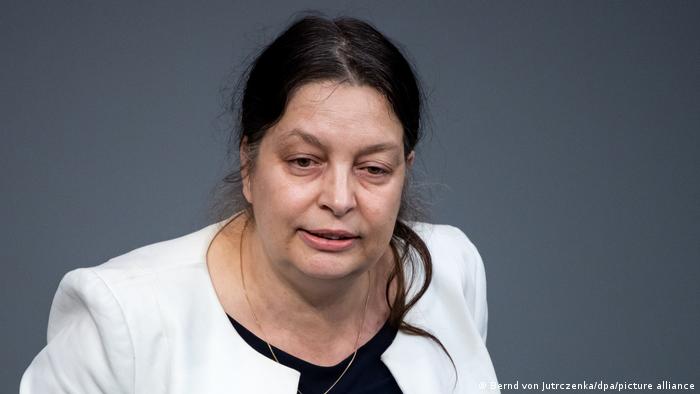
Birgit Malsack-Winkemann sat for the AfD in the Bundestag from 2017 to 2021
Kreck's application failed. The Judicial Service Court rejected him on October 13, 2022 on the grounds that Malsack-Winkemann's statements as a member of the Bundestag should not be used as a basis for such a decision. Some of Malsack-Winkemann's statements on the Internet, especially about the Corona laws and the US election and once about refugees, did not show any right-wing extremist attitude. As evidence that their case law is implausible and biased, “they are not even remotely sufficient”, neither in terms of quality nor quantity, according to the verdict.
It is “basically not that easy to subject someone who has first become a judge to disciplinary measures or even (…) to remove them from the service,” legal scholar Marion Albers from the University of Hamburg told DW. Because it should be prevented “that the government or politics in general influence the judiciary”.
Bundestag speeches are protected by Article 46 of the Basic Law. It states: “A member of parliament may at no time be prosecuted in court or in the service or otherwise held to account outside the Bundestag because of his vote or because of a statement he made in the Bundestag or in one of its committees.” The only exception is “defamatory insults”.
AfD MP Seitz was removed from the judiciary
But Malsack-Winkemann is not the first member of the justice system whose right-wing political leanings may or have conflicted with his work in the judiciary. Thomas Seitz is a member of the AfD Bundestag, legal policy spokesman for his parliamentary group and former public prosecutor in Baden-Württemberg.
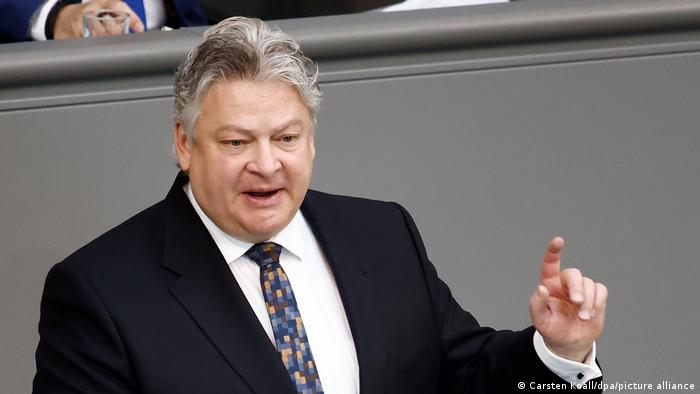
The AfD member of parliament Thomas Seitz was a public prosecutor in Baden-Württemberg before he was removed from the service
Seitz repeatedly published racist statements on his Facebook page, which is why the state's Ministry of Justice filed a lawsuit against him with the Judicial Service Court with the aim of removing Seitz from the civil service. The court finally found that Seitz had used terms and images in his statements that violated the duty of political moderation, neutrality, impartiality and loyalty to the constitution, which civil servants are subject to. Seitz has been removed from the service.
At the beginning of December this year, the service court in Leipzig decided to send the judge and former AfD member of parliament Jens Maier into early retirement because of anti-constitutional statements; however, the judgment is not yet final. The court followed a request by the Saxon Minister of Justice Katja Meier from the Greens. It was based on numerous statements made by Maier outside the Bundestag.
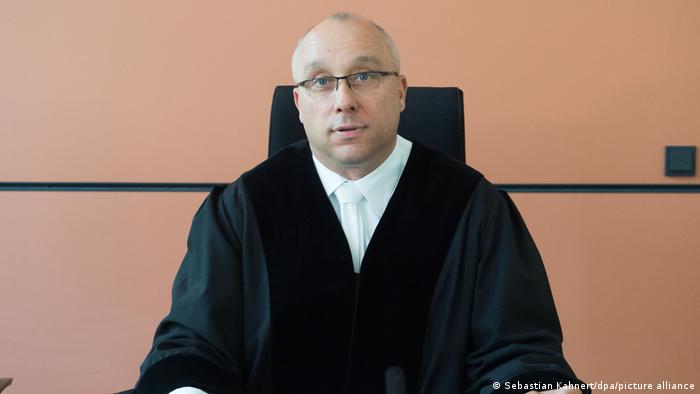
Judge Jens Maier was sent into early retirement, the judgment is not yet final
Maier is attributed to the far right of the AfD around the Thuringian state party leader Björn Höcke. For example, he spoke of a German “guilt cult” in connection with the commemoration of National Socialism and the Holocaust. And in a tweet under Maier's name it says: “If the accused fear 'AfD judges', we have done everything right.” The Saxon Office for the Protection of the Constitution classifies Maier as a right-wing extremist.
What judges can and cannot do
The freedom of expression of opinion, as guaranteed in the Basic Law, naturally also applies to judges. Like any other citizen, they can be members of political parties and publicly express political opinions – as long as such expressions of opinion do not raise doubts that they correspond to the fundamental values of the Constitution. However, a judge's political beliefs must not influence his professional work. A judge must administer justice impartially and independently of his political opinions.
“Cases like Birgit Malsack-Winkemann and Jens Maier are just the tip of the iceberg from my point of view,” says legal scholar Andreas Fischer-Lescano from the University of Kassel of Deutsche Welle. The problem of right-wing extremists in public offices does not only exist in the police and military, “but in all areas of public service, including teachers and judges”.
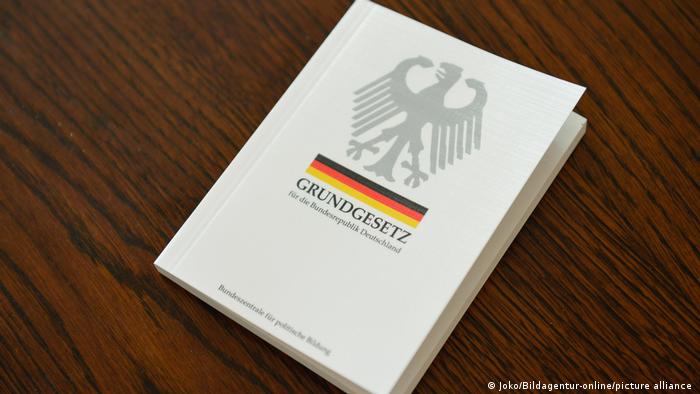
Of course, the freedom of expression guaranteed in the Basic Law also applies to judges. But their political activities must correspond to the constitution and must not influence their professional work
German federalism means that in the judiciary, too, recruitment practices, screening of applicants and disciplinary measures differ from country to country. Since 2016, for example, applicants for the judiciary have been thoroughly checked in Bavaria. Brandenburg now wants to screen all applicants for public service, including teachers and judges, to determine whether they have taken part in anti-constitutional protests, worn unconstitutional symbols, incited hatred or committed violent acts against state authorities.
Extremism- General suspicion?
But returning to stricter controls is not the way forward, says Andreas Fischer-Lescano. In 1950, the federal government under Chancellor Konrad Adenauer passed a resolution on the constitutional loyalty of public servants. As a result, these people were forbidden from being members of organizations that the federal government classified as anti-constitutional at the time. This so-called Adenauer Decree was primarily aimed at left-wing and communist organizations and reflected the radical anti-communist purges of the McCarthy era in the USA.

In the 1960s, students protested against former Nazis at universities and in the judiciary
With the radical decree of 1972 during the period of left-wing terrorism by the Red Army faction, the federal government under SPD Chancellor Willy Brandt also wanted to test public servants for their loyalty to the free-democratic basic order. Around 3.5 million civil servants were checked for compliance with the constitution until the practice was abolished in the 1980s because it seemed disproportionate. Around 1,250 applicants, mostly left-wing extremists, for school or university service, for the post office and railroad (both state-owned companies at the time) were not hired, and around 260 were dismissed.
As a result, “everyone who wanted to enter public service was initially suspected of being extremists, and that had an impact on both left and right,” says Fischer-Lescano. He is against a far-reaching scrutiny of applicants, “what we need is a sharpening of the means of a well-fortified democracy”.
Home Secretary Nancy Faeser proposes simplifying the removal of judges from office. Fischer-Lescano agrees: “It's not about abolishing legal recourse, it's about accelerating the process.”
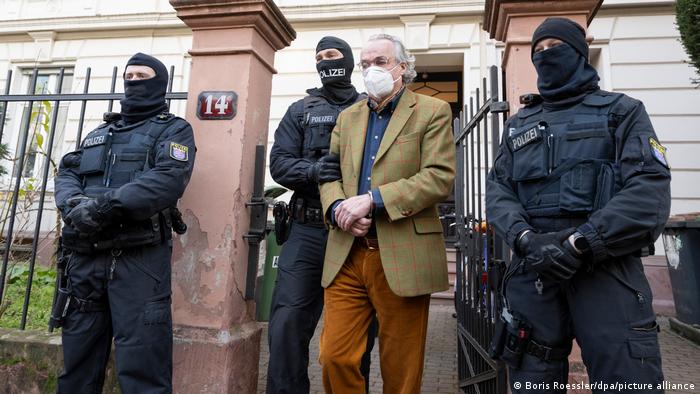
Arrest of the alleged ringleader from the “Reichsbürger” scene, Heinrich XIII Prince Reuss, during the major raid on December 7th.
The legal scholar Marion Albers sees another problem for checking applicants: “As a rule, the recruitment works when the people are in their early 30s. Both (Maier and Malsack-Winkemann) are now in their late 50s, early 60s That means there is a very considerable period of time between them, in which they have become radical right-wing politicized. And they are on duty and then radicalize themselves while on duty, so that one can of course ask oneself: are these really the recruitment criteria that are being changed? have to?”
After 1945, old Nazis ended up in the judiciary
Links between the German judiciary and the extreme political right have existed time and again since the end of the Second World War. After the war, many former National Socialists worked in high legal positions in the Federal Republic of Germany. According to a government report from 2016, more than half of the top officials in the then newly created Federal Republic of Germany's Ministry of Justice were former members of the National Socialist Workers' Party, and some had even belonged to the paramilitary SA (Sturmabteilung) up until 1945.
With the most recent large-scale raid against right-wing extremists , who are suspected of having planned a coup d'état, are again being asked today, more than 70 years after the founding of the Federal Republic of Germany, about the links between the judiciary and the extreme right in Germany.
p>