The year 2022 was marked by the war between Russia and Ukraine. A year in which we seriously dealt with the question: Does Moldova still exist as a free, democratic and European state?
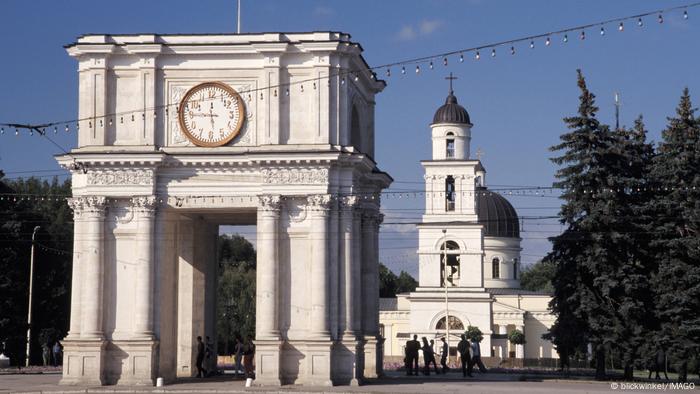
Triumphal Arch and Orthodox Cathedral in the Moldovan capital Chisinau
The end of 2022 brought a bold act by the Chisinau government into the spotlight: the suspension of the licenses of six pro-Russian TV channels in Moldova. Some of these stations are owned by fugitive oligarch Ilan Shor, who was sentenced to seven and a half years in prison for money laundering and bank fraud (for his involvement in the theft of around $1 billion from the Moldovan banking system). Others belong to people associated with the socialist pro-Russian opposition party.
It was the decision of the Extraordinary Situations Commission that argued that these six broadcasters had breached the Audiovisual Services Code on multiple occasions. News about the war in Ukraine was presented in a tendentious and manipulative way, to the point of open propaganda for Putin's aggression. “Censorship! Censorship!” raged the sanctioned television stations, complaining of a violation of freedom of expression. The Russian Foreign Ministry accused the Moldovan leadership of “cynically violating the rights of national minorities”.
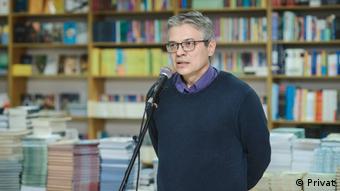
The Moldovan author and publicist Vitalie Ciobanu
The old Russian trick is repeated: Moscow only remembers human rights when it is held accountable for violating those rights. And Russia – the great “protector” of the national minorities on its territory, which, if they are not deported, as Stalin did with the Chechens, the Crimean Tatars or the Romanians in Bessarabia, today under Putin become cannon fodder in a war of annihilation against freedom-loving Ukrainians -, this Russia is shedding crocodile tears of “pity” for the Russian minority, which henceforth has to do without war propaganda. At the same time, Russia is cutting off gas and electricity to Moldova, including the Russian-speaking Moldovans, to punish that state's anti-war stance.
Moldovan reactions to the blocking of pro-Russian propaganda
In Chisinau, the reactions to the shutdown of the TV stations were different. On the one hand, the courage of the authorities to put a stop to Russian propaganda is applauded, on the other hand, there are those who say that the decision has come far too late. Years have passed in which pro-Russian broadcasters have brainwashed the people of Moldova and boosted the ratings of Putin and the pro-Russian parties. The fact is that four of the six now blocked TV stations are no longer allowed to broadcast their programs in the European Union either.
By the end of 2022, the pro-European leadership in Chisinau appears to have largely overcome its complexes and with it the fear of not being (wrongly) accused of violating democratic norms or of having irritated Russia. The government seems to realize that the much-vaunted “neutrality” enshrined in the country's constitution does not help Moldova, but on the contrary makes it vulnerable by encouraging internal and external aggressors.
This realization enabled the broad investigation of the recent anti-government protests in Chisinau, funded with dirty money and supported by Russia. The inclusion of the fugitive oligarchs Ilan Shor and Vladimir Plahotniuc in the list of American and British sanctions facilitated this release from complexes and also led to the drafting of a “Magnitsky law” against corruption in the Republic of Moldova, which is to be voted on in parliament.
Reforms in the fields of energy and defense
The year 2022 proved important for radical changes in other areas as well, such as securing energy independence from Russia and strengthening the defense sector, which has been badly neglected in the 30 years since independence from the Soviet Union. Since the Spring-Summer War of 1992, which was lost against the Russian-backed Transnistrian separatists, no one in Chisinau has seriously considered strengthening the national army.
It was falsely claimed that a neutral country like Moldova didn't need an army – much to Moscow's satisfaction. Former Moldovan Presidents Vladimir Voronin and Igor Dodon, along with other pro-Russian politicians, even suggested abolishing the army altogether. Plahotniuc, the former strongman in Chisinau, “inflated” the police apparatus to defend it from its own citizens and not from an outside aggressor.
This deplorable mentality has finally been overcome. The fall of a few Russian missiles on Moldova's territory was arguably the last compelling argument that the country needs robust military forces. For the first time, the draft budget for 2023 provides for a 75 percent increase in the defense budget for the purchase of several air defense systems. It's not enough, but it's a start.
2023 – there is no turning back
In the year that is now drawing to a close, Moldova has been granted EU candidate status alongside Ukraine, which is fighting for its own freedom and that of Europe as a whole. In 2022 in the Republic of Moldova, history suddenly accelerated, putting us in the midst of dramatic situations, showing us the price of independence and freedom, forcing us to answer the question: are we ready to defend it?
< The ban on pro-Russian propaganda channels caps a path of awareness-raising that Moldova and its leadership have embarked on under the pressure of a major existential threat - from ever-fading hope that neutrality offers protection to necessity to make a clear decision about whose side you are on. Between war and peace, between truth and lies, between democracy and tyranny, there is no middle ground. This course needs to be consolidated in 2023. There is no turning back. An act of revenge by Russia against the Republic of Moldova would mean the annihilation of this state and its people.
Vitalie Ciobanu is one of the most well-known writers and journalists in the Republic of Moldova. He is President of the Moldovan PEN Club.
Adaptation from Romanian: Robert Schwartz