For more than two weeks, many Jordanians have been demonstrating against the increased cost of living. If nothing changes, the protests could intensify. But the government lacks the money and courage to implement reforms.
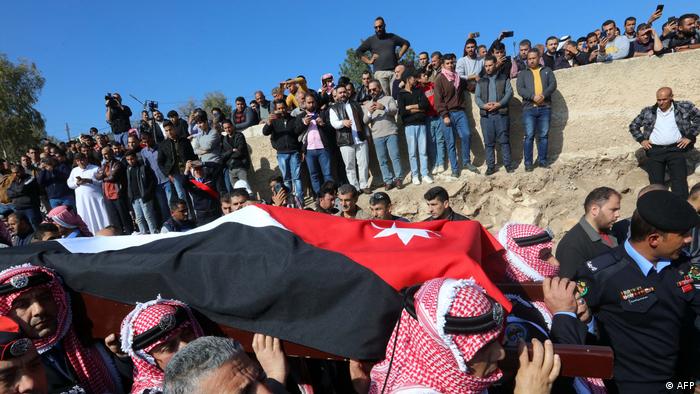
Condolences: Funeral of one of the police officers killed
Three police officers died in a shootout in southern Jordan, as did the suspected gunman. Violence is escalating around the city of Maan, which has been the center of ongoing social protests for several days. A senior police officer had already been killed in the context of the protests last week. The police then arrested more than 40 people nationwide.
Many Jordanians are shocked by the police officers' deaths, says Edmund Ratka, head of the office of the CDU-affiliated Konrad Adenauer Foundation in Amman. They were particularly shocked by the brutality of the conflict: The police officers were involved in the exchange of fire during a house search. Their mission: to arrest a person suspected of being responsible for the murder of the first police officer. According to the pro-government daily Jordan Times, the suspects are followers of the so-called Takfir ideology, an extremist political interpretation of Islam, which is also followed by the terrorist organization al-Qaeda and the jihadist militia “Islamic State” (IS).
It is of course unclear to what extent the murders are related to the protests at all. The thesis that the protest movement sympathizes with jihadists or even shows solidarity with them is highly unlikely, says Ratka. “The jihadists have almost completely lost the support of the population. Most Jordanians have completely different concerns and are not pinning their hopes on representatives of extremist Islam.” It cannot be ruled out that extremists act as political “free riders” in the protests. Conversely, a real or at least alleged involvement of jihadists could theoretically weaken the protest camp morally or serve as an excuse for the government to adopt a tougher approach.
Strikes are expanding
The protests were preceded by a strike by truck and bus drivers that began in early December. They call for a reduction in fuel prices and the abolition of state taxes. In the course of the strike, unrest also broke out in other regions of the country. In the meantime, they have covered several other parts of Jordan. At the end of last week, numerous shopkeepers also joined the strike and kept their shops closed. There were also numerous sit-ins and road closures. Many industrial companies also remained closed.
There were problems with the Internet in many places, and communication via social media was severely restricted. According to the news channel Al-Jazeera, the police unit for fighting cybercrime announced that it had blocked the video portal TikTok to prevent its “abuse”.

Tension: Jordanian security forces in the city of Maan, December 16, 2022
In the context of the protests, MP Ahmed al-Qatawneh warned of a further escalation. “We cannot guarantee that these protests will be brought under control in the coming days. The government must take its responsibilities and step down as it has no plan to solve the fuel problem. What we need is a reduction in fuel prices,” he said According to media reports.
King Abdullah II, on the other hand, warned the demonstrators: he declared last Friday (December 16) that tough action would be taken against anyone who raised a weapon.
In order to accommodate the demonstrators and strikers, the government had come to an agreement first decided with Parliament last week to provide financial support to truck drivers – many of whom work on their own account – and not to increase kerosene prices during the winter season. At the same time, the banking association decided to defer due installments in the current month free of charge.
High economic pressure
But the demonstrators were unimpressed. They see one of their main demands, the lowering of fuel prices, as unfulfilled. The amount of these is essentially based on the surcharges imposed by the state. Since 2019, the tax rate for unleaded petrol has been 121 percent, Super '95 petrol is even taxed at 182 percent, kerosene and diesel at 52 percent. In addition, at the beginning of the current year, the government increased the price of diesel eightfold and the price of petrol fivefold.
The increases affect a population that has already been under severe economic pressure, not just since the corona pandemic and now the Russian attack on Ukraine and the associated wheat crisis. Unemployment is almost 20 percent, and the country is also suffering from chronic water shortages.
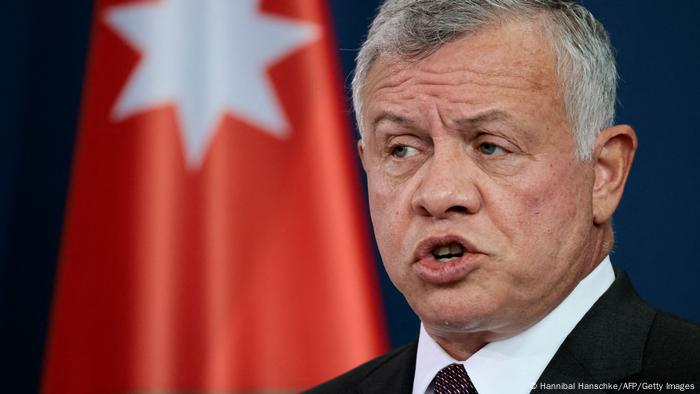
Warning ahead further use of force: the Jordanian King Abdullah II.
“Many citizens are asking themselves more and more urgently how they can pay for the rising cost of living,” says Jordan expert Ratka. Heating oil, diesel, a general rate of inflation in general: that affects many people. According to Ratka, these questions had already sparked protests in previous years, which then developed a certain momentum of their own. “Then it can easily happen that the government is accused of mismanagement or that the economic division of society drives people onto the streets.” But the extent of the current protests is unusual.
Frustration in the South
The fact that the protests started in southern Jordan is not surprising, says political scientist André Bank from the German Institute for Global and Area Studies (GIGA) in Hamburg. This is where the focus of the Jordanian transport industry lies, which is suffering particularly from the increased energy prices. The inhabitants of the southern parts of the country have long proved loyal to the Hashemite royal house. But this changed when this transport industry fell into a crisis in the 1980s – after the end of the Iran-Iraq war – that has persisted to this day. “For a long time now, the Jordanians living there have had the impression that they have been given up by the government and are therefore also excluded from economic participation. This turns them against the royal family,” says Jordan expert Bank.

Burning car tires on a street near the city of Maan, December 16, 2022
“Spring” unlikely
It is currently unclear how the state leadership intends to appease the demonstrators in the long term. With a view to the economy and administration, the king has launched a number of reform initiatives, says Edmund Ratka. “But they're not taking hold yet. Rather, it seems as if the previous social model – economic participation against loyalty to the monarchy – is reaching its limits.” However, experts do not expect a collapse, an overthrow or, to a certain extent, a delayed revolutionary “Arab Spring” in Jordan in the foreseeable future.
The government is dependent on outside support, says Jordanian political analyst Sameh al- Mahariq. Of course, it has had this for a long time. “Jordan receives massive development aid, from the USA as well as from Europe and the Gulf States,” says André Bank. “Nevertheless, the government lacks the resources to meet the demands of the population.” That, he suggests, is also due to home-grown problems. The country is experiencing massive population growth. At the same time, it has a bloated state sector, combined with a high level of corruption. If the government wanted to accommodate the demonstrators in the long term, the political and social elite would also have to make compromises. “It is doubtful that she is willing to do this,” says Bank.