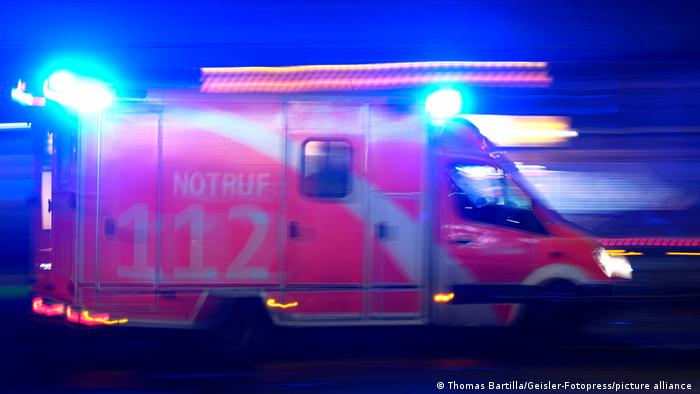
Many operations, little staff: the rescue services in Germany are reaching their limits. How could that happen? What are the ways out?
“People call us who are lonely and have no contacts.”
Thirteen calls in 24 hours – Kathrin Möller has worked an intensive shift as an emergency paramedic: “The stress is quite high.”< /p>
Möller has been working in the emergency services in north-west Germany for almost 14 years. The burden is not only high for her in the district – in general, the situation of the rescue service in the country is so tense that associations are warning of the collapse. “We run the risk of the emergency rescue system in Germany collapsing,” warns Oliver Hölters from the staff side of the Caritas Labor Law Commission. “The population feels safe because they are promised that help will be on the way everywhere in Germany in just a few minutes. This promise is already a deceptive promise.”
Only recently, after a bus accident in Berlin, emergency services arrived late at the scene of the accident because no ambulance was available. Several problems at the same time are troubling the rescue service: According to associations, there are 20 percent more operations than in the previous year, plus there is a lack of staff and the rescue workers are overburdened. Paramedics leave the service because they have to put in more and more hours of work. In addition, clinics and hospitals are also reaching their limits: here, too, there is a lack of nursing staff, which means that fewer patients can be admitted and are turned away at the emergency room.
Paediatricians in crisis mode
Oliver Hölters is a co-initiator of the “Alliance for Rescue Services”, which has just been founded and to which five other associations belong, including the German Professional Association for Rescue Services. Its deputy chairman Frank Flake, himself a long-time emergency paramedic and head of department, describes the situation in an interview with DW: “A few years ago, as an ambulance service, you could drive to the nearest hospital. You may not be able to do that anymore because the hospital can't take any more. So you have to keep driving, which turns what was supposed to be an hour into an hour and a half or two, maybe. Combined with the other factors, it ends up being a cycle that keeps the system collapsing.” .
Emergency paramedic Kathrin Möller regularly sees this downward spiral during her operations. Of the thirteen calls she's made on her past 24-hour shift, only two have been true emergencies. The rest were petty missions. “Recently we had a young man in his early 30s who called us because he had an eyelash in his eye.” According to Möller, such assignments take up time, cost energy and are ultimately “infinitely frustrating.”
Many providers, little clarity
These trivial trips are numerous – and they tie up the urgently needed staff. The emergency services in Germany are deployed more than 30,000 times a day. A study commissioned by the Bertelsmanns Foundation and the Björn Steiger Foundation from April 2022 showed that a third of these assignments are not emergencies. In many cases, rescue services are now “social services,” according to Flake. “People call us who are lonely and have no contacts. If you call 112, nice young people come and talk to you. It's come that far.”

Frank Flake from the German Professional Association for Rescue Services is committed to reforms
In Germany there is actually a wide range of services: General practitioners, weekend practices, emergency admissions to clinics, the on-call service of the Association of Statutory Health Insurance Physicians, which can be reached on 116/117 . And 112, under which ideally the emergency services can be with the patient in a few minutes.
But as wide-ranging as the offer is and in some metropolitan areas it makes up a dense network, it is also non-transparent. “At the moment patient flows are completely uncontrolled, everyone is doing what comes to mind,” says Flake. Means: if a patient calls 112, the emergency services will come, even if it turns out on site that it is not a life-threatening emergency.
Reform on hold
There are many ideas for reforming the encrusted system: one of them is the central joint control center for the numbers 112 and 116/117, which screens out the cases that are not emergencies and forwards them to other practices. There is such a system in Lower Austria, for example. An expansion of telemedicine is also conceivable, with which doctors can give initial information over the phone and possibly issue prescriptions.
In some communities in northern Germany, the concept of community emergency paramedics is also being tested. He is supposed to take the trips that are not emergencies away from the emergency services – for example, older people who are insecure and lonely and therefore dial 112. These pilot projects have already been scientifically monitored and it has been shown that such a community paramedic actually relieves the system.

In Lower Austria, a control center coordinates emergency doctors and paramedics
However, comprehensive reforms and new concepts like this have not yet been implemented. Even before the corona pandemic, a reform proposal by the then Health Minister Jens Spahn was on the table. For example, it provided for a joint control center from 112 and 116/117. But there is one sticking point that makes any reform difficult: rescue services are a matter for the federal states in Germany. Each federal state decides for itself how to structure its rescue service.
For associations like “Alliance for Rescue Services” a brake in the crisis. For example, community emergency paramedics could not be rolled out across the board because the Emergency Services Act (which each state completes individually) does not allow for deployment and funding. “The only viable solution is to buy new ambulances, although everyone knows that's the wrong approach,” says Flake. Because without personnel, the additional ambulances stand still. In fact, however, cities and districts often react in exactly the same way to problems in the emergency services. It was only last year that the city of Cologne decided to purchase 85 new ambulances for over 18 million euros.
Countries want the upper hand
Spahn's reform provided for some powers to be withdrawn from the federal states. Associations such as the Alliance for Rescue Services want to go one step further: the Basic Law must be changed. Because at the moment, according to the law, the rescue service is only a transport service and not part of the emergency care. The federal government has no access and cannot, for example, deploy community emergency paramedics. In order to change that, the Basic Law would have to be changed – which the federal states would have to agree to. And they fight against it.
Lower Saxony's social affairs minister, Carola Reimann, said of the reform plans: “This means that there are central federal requirements and we cannot develop differentiated local solutions. According to the Basic Law, however, the federal states are responsible for the rescue service. And that makes sense and That's right: The best way to meet the requirements from the Harz mountains to the coast is with the state legislation, because the local conditions are not uniform either in Germany or in Lower Saxony.”
The reform is on hold, the new one The federal government has not yet pulled them out of the mothball, even in the course of a hospital reform that is now being sought.
And so the rescue service remains a patchwork quilt in Germany. This goes so far that the assistance period, i.e. the legal requirement for when an emergency service should be with the patient, varies. In North Rhine-Westphalia it is twelve minutes, in Hesse it is ten minutes. Apart from the fact that these two minutes of variance cannot be explained medically, these deadlines are being met less and less. In Saxony-Anhalt, the emergency services only managed to get to the patient within the specified period in 83 percent of the cases last year. The rest had to wait – even if that could be potentially life-threatening.