A proposed prisoner exchange treaty between Belgium and Iran raises many questions. Convicted terrorists may soon be free.
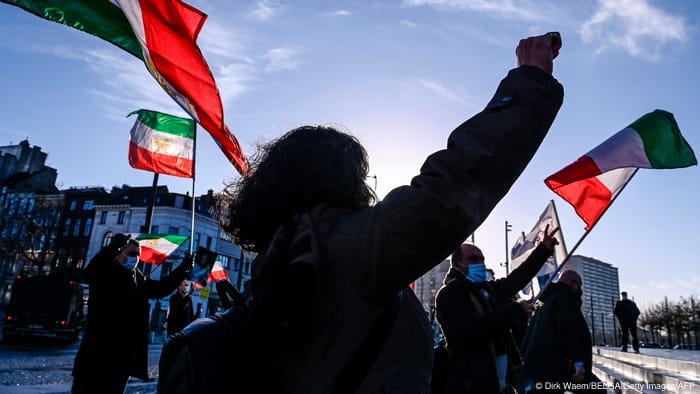
Iranian protesters in front of courthouse in Antwerp 2021
A controversial draft treaty that would allow the exchange of prisoners between Brussels and Tehran is to be ratified by the Belgian parliament in the near future. Parliamentarians must now vote on a government bill. The deal had already been approved after the first reading on Wednesday (06.07.22). It only spoke of “transfer of convicted persons”. For the Iranian opposition and human rights activists, however, it is clear that this is primarily about a convicted terrorist: Assadollah Assadi.
Assadi was sentenced to 20 years in prison in 2021 for preparing a terrorist attack on exiled Iranians. In June 2018, Belgian investigators foiled a bomb attack in Villepinte near Paris. Assadi is said to have been instrumental in pulling the strings in the background. At that time he was officially accredited in Austria as the third Counselor. The Belgian court considered it proven that Assadi is an agent of the Iranian secret service.
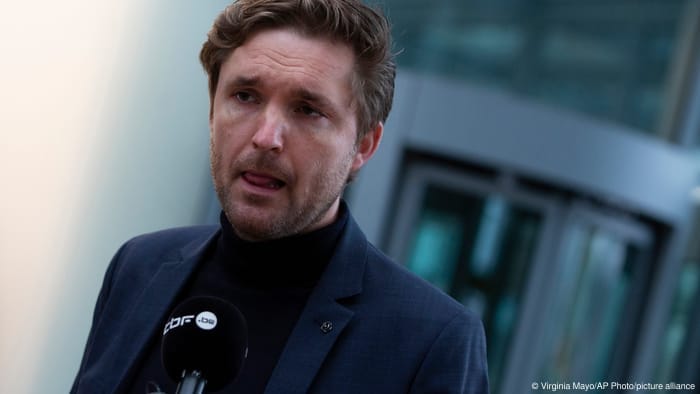
Assadi's lawyer Dimitri de Bec
“Impunity for Terrorists”
The fact that this terrorist may now be extradited to Tehran and very likely be released there is causing criticism. Human rights organization Amnesty International warned this week that the proposed deal between Belgium and Iran could be used to “grant impunity to Iranian officials and agents responsible for gross human rights abuses and crimes under international law”.
< p>More than 400 Iranian human rights activists, dissidents and family members of victims of Iranian state repression and violence had asked the Belgian parliament not to ratify the planned prisoner exchange agreement with Iran.
“The government in Brussels is signing a contract with a country that will send its agents to Europe to kill its critics and the opposition with impunity,” criticized Taghi Rahmani in an interview with DW. Rahmani, who was a political prisoner in Iranian prisons for a total of 14 years, has lived in exile in France since 2012.
 < p>Evin prison in Tehran
EU citizens detained in Iran
According to the Brussels government, it wants Belgian citizens imprisoned in Iran to be released. “It is our moral duty to free innocent compatriots who are being held abroad,” Justice Minister Van Quickenborne told Parliament last week. “Other countries are also exchanging prisoners with Iran. The difference is: they do it clandestinely. We want to regulate it contractually.”
Only last week it became known that a Belgian citizen is in prison in Tehran. According to media reports, 41-year-old Olivier Vandecasteele has been in solitary confinement since February 24 because of secret service activities in Tehran's notorious Evin prison. According to his friend, his health is very poor. Vandecasteele had worked for various non-governmental organizations in recent years, most recently for the Norwegian Refugee Council (NRC). The organization supports refugees.
An Iranian-Swedish university professor who worked at the Free University of Brussels is also threatened with the death penalty in Iran. The emergency doctor Ahmad Reza Jalali was arrested in 2016 when he was invited by the University of Tehran to travel to Iran for an academic exchange.
He was later convicted of alleged espionage against the Iranian state. “A verdict whose legitimacy is being questioned by both the United Nations and Amnesty International,” said Green Party politician Lamya Kaddor, a member of the German Bundestag, in May 2022.

Jalali (here in Barcelona 2014) faces the death penalty in Iran for espionage
EU as a community of values?
“Brussels is considered the headquarters of the European Union. A union that is actually a community of values and is committed to democracy all over the world,” says Iranian activist in exile Rahmani. “But if the lives of Belgian citizens are in danger, Belgium is willing to sign a treaty with a country like Iran and release convicted terrorists. With this treaty, Iran can guarantee its agents that they will be brought back to Iran. what a crime they commit in a constitutional state.”
“Iran is doing everything to get Assadi released,” stressed Belgian politician Darya Safai in an interview with the London-based Persian-language TV channel Iran International. Safai, who was born in Tehran and has been a member of the opposition party, the “New Flemish Alliance”, in the Belgian parliament since 2019, added: “We know that big European countries like France support this treaty with Iran. Their citizens also became taken hostage in Iran. I was informed that Iran has demanded the surrender of Assadollah Assadi in return for the release of EU citizens. Unlike France, where the President alone can decide on a prisoner exchange, in Belgium the parliament must be involved.”
Watch video 02:03
Online attacks against women activists
Activists deeply concerned
The Iranian human rights activist Mansoureh Shojaee also sees a fatal error in this contract. “It's about a ratified treaty with a state that is known to be taking political hostages and trading in human lives. A European country now officially wants to cooperate with Iran on this level. That's frightening for Iranian opposition figures, women's and human rights activists.”
Shojaee has been one of the leading figures in the Iranian women's rights movement for over 20 years. She was arrested several times because of her commitment, most recently on December 27, 2009. Six months after her release, Shojaee was able to leave Iran. She now lives in the Netherlands. “Women's and human rights activists avoid entering countries that have a prisoner exchange treaty with Iran, such as Tajikistan. There they can be arrested under any pretext and extradited to Iran.”