With the laying of the foundation stone for its first battery factory in Salzgitter, the car manufacturer Volkswagen is pushing ahead with the switch to electric cars. Salzgitter is also said to be the blueprint for cell factories across Europe.

A computer simulation of Volkswagen's battery cell factory in Salzgitter
“In the future, we will take all relevant fields into our own hands and thus secure a strategic competitive advantage in the race for the pinnacle of e-mobility,” explained VW Technology Manager Thomas Schmall at the laying of the foundation stone for the battery factory in Salzgitter, Lower Saxony. Also present: Federal Chancellor Olaf Scholz and Lower Saxony's Prime Minister Stephan Weil. Volkswagen is showing what the sustainable and climate-friendly future of mobility could look like, explained Scholz. “Today is a good day for the automotive industry in Germany and Europe.”
In July, the new VW company PowerCo was launched, which is to lead the battery business worldwide. Together with partner companies, this should invest more than twenty billion euros in the development of the business area by 2030, turn over twenty billion euros a year and employ up to 20,000 people in Europe alone, 5,000 of them in Salzgitter.

The construction site in Salzgitter on the day the foundation stone was laid
Combustion engines are coming to an end
The project is “a prime example of ecological and social transformation,” said Daniela Cavallo, head of the works council. According to the works council, there are likely to be 5,000 new jobs in the city in Lower Saxony, and almost 7,000 are currently working there in the existing engine plant.
Salzgitter is said to be the blueprint for cell factories throughout Europe. By 2030, the Volkswagen Group wants to operate six cell factories in Europe together with partners with a total output of 240 gigawatt hours.
The production of combustion engines at VW will continue to decrease and will be phased out in the long term. The PowerCo from Salzgitter is to control the majority of the group's battery business.
Volkswagen's “Salz-Giga”
In Salzgitter – the Salz-Giga project is called an allusion to Tesla – the entire value chain is involved, from the purchase of raw materials to production and recycling. A research center is also attached. From 2025, VW wants to produce the so-called unit cell in the new plant, which is being built next to engine production. It is to be used in four out of five Group vehicles and will halve the production costs for the central battery elements.
Starting from a total electrical energy of 20 gigawatt hours (GWh), an annual amount of 40 GWh is being aimed at in Salzgitter over several steps on. That should be enough to equip half a million electric cars.
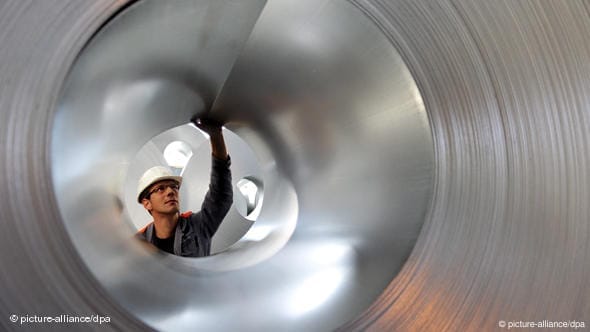
So far, the small town in Lower Saxony was better known for the steel tube production of Salzgitter AG
From Salzgitter out into the world
This size is also the goal for five other cell plants in Europe. In addition to Salzgitter, Skellefteå in northern Sweden and Valencia in Spain have already been confirmed. For the other three locations, there should be applications from Germany and Eastern Europe, among others. Possible gigafactories in North America are also in preparation. In China, VW is working with the cell manufacturer Gotion, in Europe with Northvolt from Sweden.
Volkswagen is also hoping for more standardization from its plans for so-called standard factories for cell production – based on the model of the various vehicle construction kits and platforms . Together with the major supplier Bosch, the equipment of complete plants is checked. “This is how factories are created that can be quickly converted to other product and production innovations,” explains the group.
dk/hb (dpa, rtr)