Bluff or alert? How dangerous is Vladimir Putin's threat of a “quick response” to interference in the Ukraine war? By Yuri Rescheto from Riga.

Russian President Vladimir Putin
If you talk to Latvians these days, most of them do not rule out a potential Russian attack on their country. Latvia not only shares a long common border with Russia, but also a long common Soviet past, which is simply called occupation here.
The three Baltic states have been independent again since the 1990s. And they want it to stay that way. Especially now. Because since the Russian attack on Ukraine, those who have not taken the warnings from US secret services about this attack seriously are particularly alarmed.
For many, the words of Russian President Vladimir Putin at a meeting of top officials in St. Petersburg sounded alarming. If someone got directly involved in the war, Putin threatened, his country would react at lightning speed. “We have all the tools for it,” said the Kremlin chief, “and we won't brag. We'll use them if necessary. And I want to that everyone knows.” The necessary resolutions have already been passed.
More than saber rattling?
But which ones exactly? The independent Russian military expert Yuri Fyodorov does not rule out that Putin meant nuclear weapons because in his threat he clearly meant the countries that possess nuclear weapons, above all the USA and Great Britain. In an interview with DW, Fyodorov suspects: “Putin and his advisors have come to the conclusion that Ukraine cannot be defeated with conventional weapons. The Kremlin sees nuclear weapons as the last resort (Latin for the last argument – editor's note). , the weapon that decides the outcome of war.”
In addition to the nuclear weapons, the Russian president could also have meant the Russian Zirkon hypersonic missile, Fjodorov suspects, a ship-based missile that attacks sea targets and is called SS-N-33 in the NATO classification. The Zirkon rocket does fly fast, but not far, according to Fyodorov, only 300 to 400 kilometers: “Nevertheless, Putin likes it, he's very proud of it.” The military expert nevertheless doubts the effectiveness of Zirkon: “The high Speed is important for destroying moving sea targets so they can't stray too far from the target point.” Most ground targets are immovable, so high speed doesn't play the greatest role there. “In addition, the rocket has to reduce its speed again when re-entering the dense atmosphere, otherwise it will burn up.”
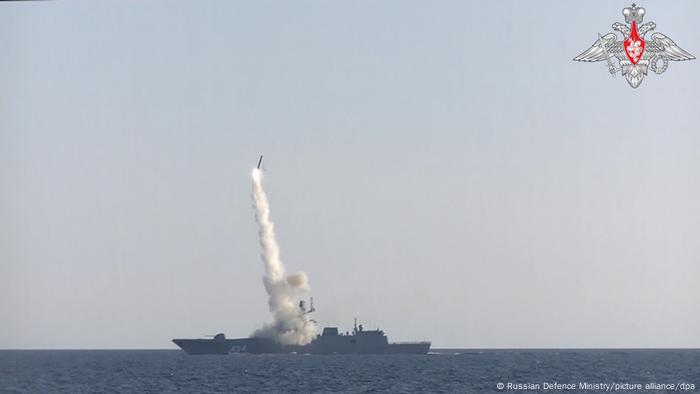
Launch of a Zircon hypersonic missile from a Russian destroyer, archive photo July 2021
Response to Ramstein
For Andrei Kolesnikov from the former Carnegie Moscow Center (had to by order of the Russian government in April 2022 close – editor's note), the Kremlin chief's words are a reaction to the NATO summit meeting at the US military base Ramstein in Germany.
The political scientist analyzed Putin's threat to DW as follows: “Everything he says is not strategic, but tactical, reactive and opportunistic.” Kolesnikov notes that Putin can change his plans depending on the situation: “When it says that everything is going according to plan, nobody knows exactly what this plan consists of and what its goals are.” Putin probably doesn't have any rigid goals at all, but can set them adapt to the respective situation.”It depends on what happens in the West and at the front.”
Kolesnikov sees in Putin “without a doubt a person who has been driven into a dead end and is acting more and more brutally. ” Putin's rhetoric has also become more brutal: “He was never particularly open to dialogue, but in the current state negotiations are merely optional for him.”

Defense ministers from more than 30 countries met in Ramstein on Tuesday to discuss the war in Ukraine
The independent Russian political expert Abbas Galyamov downplays Putin's words as pure propaganda. In a DW interview, he compared the Russian president to a tiger: “But everyone understood that the tiger is made of paper. He has to prove to everyone that that's not true, but he can't do anything. So all he has to do is say words.” These words are an attempt to convince a certain part of his addressees that the Kremlin boss is still strong.
“We have the facts: Russia has attacked, there are war crimes and a heroic defense by the Ukrainians ” – states Galyamov. For Western politicians, these facts are decisive for their actions. That's why the political scientist doesn't expect the West to suddenly “go in a completely different direction” after Putin's new threat. Galjamov sums it up that Putin's mistake is that he still thinks his words carry weight.