Concern is growing in Moldova that it will become the next target of Russian aggression. Alleged attacks in the pro-Russian separatist region of Transnistria do not bode well, says Vitalie Ciobanu.

The coat of arms of the internationally unrecognized pro-Russian separatist republic of Transnistria
The period in which we in Moldova due to Ukraine's heroic resistance to Putin's aggression, including the great military success – the sinking of the Russian Black Sea Fleet's flagship “Moskva” – felt relatively safe is over. The situation in the separatist region of Transnistria does not bode well.
On Monday, 25. On April 20, 2022, the second day of Orthodox Easter, the Secret Service (KGB) headquarters in Tiraspol, the capital of the breakaway region, was attacked with mortars. There were no injuries, the building was deserted at the time. The next day, April 26, other military incidents occurred in Transnistria: the destruction of two telecommunications antennas in the Grigoriopol district and explosions in Parcani, a town 13 kilometers from the border with Ukraine, and at an airfield in Tiraspol. More similar episodes cannot be ruled out.
Russian presence in Transnistria
A “worst case” would be, for example, an act of sabotage at the Cobasna military depot, which is under the control of illegally stationed Russian troops. It stores around 20,000 tons of Soviet ammunition that was withdrawn from the former communist countries of Central and Eastern Europe in the early 1990s. Neither the authorities in the Moldovan capital Chisinau nor foreign experts have access to this camp. There is no information about the condition of the ammunition.
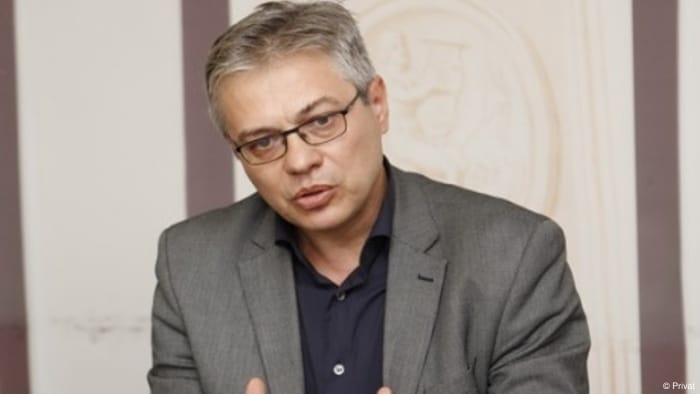
The author Vitalie Ciobanu is the President of the Moldovan PEN clubs
Repeated calls from Chisinau to Moscow to move the arms from Cobasna to Russia went unanswered, as did the demand to withdraw around 2,000 Russian soldiers from Transnistria. The OSCE, in which Russia has a strong influence, has proved utterly ineffective, supporting Russian interests rather than Moldova's legitimate demands to eliminate this source of insecurity that hangs over our heads like the sword of Damocles.
Fake news and escalation
The first concrete indication that Russia has “targeted” Moldova since the outbreak of the war against Ukraine came from statements by Russian General Rustam Minnekayev, deputy commander of the Central Military District. He spoke openly of an upcoming “second phase of the special operation” consisting of taking control of Ukraine's south-west Black Sea coast and creating a land corridor to Transnistria, where “there are cases of violations of the rights of ethnic Russians”. A brazen lie. The region is fully controlled by Moscow – who should violate the rights of the Russian-speaking population? It is not Russian-speaking residents who are intimidated and terrorized, but Romanian-speaking residents and their institutions, including schools that are under the Ministry of Education in Chisinau. Moldovan farmers who have been subjected to the terror of the separatist militias for about 30 years are being harassed. But when did Russians care about the truth?
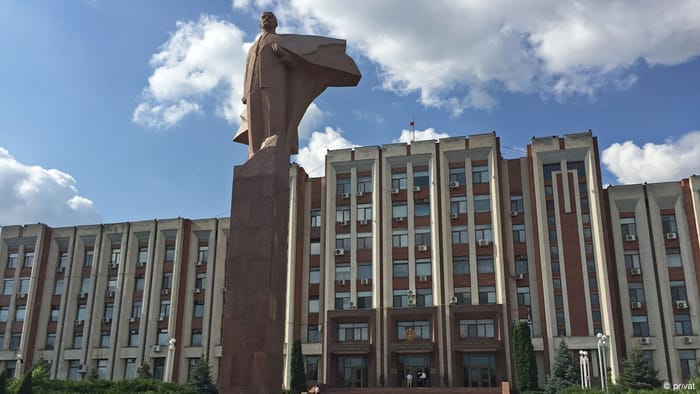
The Lenin statue in front of the “Supreme Soviet”, the parliament in Tiraspol
Wiktor Wodolatsky, First Deputy Chairman of the State Duma Committee on CIS Affairs, Eurasian Integration and Relations with Compatriots, went one step further: the “Nazism” of the rulers in Chisinau, which was supported by “their Romanian protectors”, must be analogous to that scenario used in Ukraine.
Symbols of hate and war
Last week, Russian Foreign Ministry spokeswoman Maria Zakharova and Russian MP Alexei Pushkov criticized Moldovan President Maia Sandu for daring to ban Russian symbols of hatred and war: the so-called St. George ribbon. as well as the letters “Z” and “V”. This law was approved by the pro-European parliamentary majority in Moldova.
The pro-Russian opposition – the bloc of communists and socialists led by former presidents Vladimir Voronin and Igor Dodon, and the party of the fugitive Ilan Shor (“architect” of the 2014 bank scam in which the equivalent of a billion euros disappeared) – protested ;against it and threatened to appear at the parade on May 9, on “Victory Day”, with Putin's insignia on his chest, despite the hefty fine of almost 500 euros. Thieves, bandits, criminals in the Republic of Moldova, with or without “white collars”, have always been Russia's agents of influence in the former Soviet area.
Scenario like in eastern Ukraine
The Office for Reintegration Policy – the structure of the Moldovan government for Transnistria – said that Monday's shelling of the KGB building in Tiraspol was only an excuse to tighten the security situation in the region. After the warlike tones of Russian politicians about a “corridor” to Transnistria, the Russian ambassador in Chisinau, Oleg Vasnetsov, was summoned to the Moldovan foreign ministry. Shortly thereafter, Russian Deputy Foreign Minister Andrei Rudenko delivered a reassuring message: “Russia sees no threat to its Transnistrian citizens and remains committed to a peaceful solution to the Transnistrian issue, while respecting the sovereignty and integrity of the Republic of Moldova.”

We are witnessing a game of cat and mouse, probing the responsiveness of the authorities in Chisinau to a possible Russian action in the region.
The Republic of Moldova is constitutionally neutral and in the current conflict has asked all states, including the Russian Federation, to respect this status. But Russia will not stumble over Moldova's neutrality and could always recognize the independence of the separatist region on the left bank of the Dniester. What could then follow is a military intervention to “protect its citizens” – under the same scenario as in the self-proclaimed republics of Luhansk and Donetsk in eastern Ukraine, on February 24, 2022, or in August 2008 in Georgia after Moscow recognized the independence of South Ossetia. Only a massive diplomatic intervention by the Western states was able to stop the Russian tanks a few kilometers from the Georgian capital Tbilisi.
The neutrality did not prevent the pro-European government in Chisinau from sharply restricting Russia's aggression against Ukraine condemn and to support Kyiv as much as possible. Solutions should now be found urgently so that the Republic of Moldova is not drawn into the maelstrom of war.
Vitalie Ciobanu is one of the best-known writers and publicists of the Republic of Moldova. He is President of the Moldovan PEN Club.
Adaptation from Romanian: Robert Schwartz